
Why Search and Seizure Laws Matter in Everyday Life
Few areas of U.S. constitutional law affect daily life as directly as search and seizure laws. Whether during a traffic stop, a police knock at your door, or a phone search during an arrest, these rules determine how far law enforcement can go—and where the Constitution draws the line.
At the heart of search and seizure laws is the Fourth Amendment, a core protection designed to balance public safety with individual privacy. Understanding search and seizure laws explained in plain English helps ordinary citizens recognize their rights and professionals apply constitutional standards correctly.
This guide breaks down search and seizure laws in the USA from the ground up—what they are, why they exist, and how they work in real-life situations. Part 1 focuses on the foundations: the Fourth Amendment, what counts as a “search” or “seizure,” and why warrants and probable cause matter.
The Constitutional Foundation of Search and Seizure Laws
The legal backbone of search and seizure laws is the Fourth Amendment to the U.S. Constitution. It protects people from government intrusions that are considered unreasonable, not all searches outright.
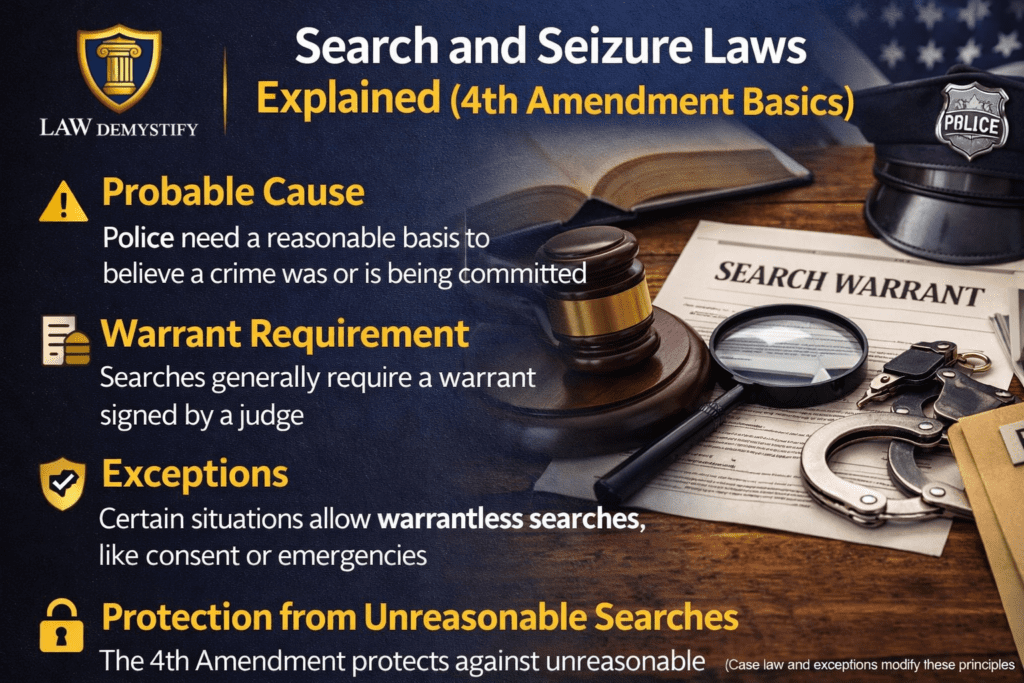
The Fourth Amendment states that individuals have the right to be secure in their “persons, houses, papers, and effects.” This language may sound old-fashioned, but courts have consistently interpreted it to cover modern realities—cars, phones, digital data, and more.
Understanding search and seizure laws explained starts with one key idea: privacy is the default, and government intrusion is the exception. Law enforcement must justify searches, usually through warrants backed by probable cause, unless a recognized legal exception applies.
What Is a “Search” Under Search and Seizure Law Explained
A “search” under search and seizure laws occurs when the government intrudes into an area where a person has a reasonable expectation of privacy. This standard has two parts: the individual expects privacy, and society agrees that expectation is reasonable.
For example, entering a private home, opening a locked phone, or searching a closed backpack are all considered searches. On the other hand, what someone exposes to the public—like items visible on a car seat—may not be protected the same way.
Courts interpreting search and seizure laws explained focus less on labels and more on practical realities. The question is not what police call their action, but whether it violates a protected privacy interest.
What Counts as a “Seizure” in Search and Seizure USA
A seizure happens when law enforcement meaningfully interferes with a person’s freedom or property. This includes physical detention, taking personal belongings, or restricting movement during encounters.
Under search and seizure laws in the USA, a person is seized when a reasonable individual would not feel free to leave. This standard applies to arrests, traffic stops, and certain investigative detentions.
Property seizures are also covered. If police take your phone, vehicle, or documents, constitutional rules apply. Understanding search and seizure laws explained helps clarify when law enforcement actions cross from voluntary encounters into constitutionally regulated seizures.
The Role of Warrants in Search and Seizure Laws
A search warrant is the gold standard under search and seizure laws. Warrants are written orders issued by judges that authorize specific searches in specific places for specific items.
To obtain a warrant, law enforcement must demonstrate probable cause—facts showing a fair probability that evidence of a crime will be found. Warrants must also describe the location and items with particularity, preventing fishing expeditions.
This requirement is central to search and seizure law explained because it ensures neutral judicial oversight before privacy is invaded. When police follow warrant rules correctly, searches are far more likely to withstand constitutional scrutiny.
Probable Cause: The Engine Behind Search and Seizure Laws
Probable cause is a flexible but critical concept within search and seizure laws. It is more than a hunch but less than proof beyond a reasonable doubt.
Courts evaluate probable cause based on the totality of the circumstances. Officers may rely on observations, witness statements, informant tips, or evidence gathered during lawful encounters.
Understanding search and seizure laws explained requires recognizing that probable cause is judged objectively. What matters is whether a reasonable officer, given the same facts, would believe a search or seizure is justified.
Unreasonable Search and Seizure Explained Simply
The Fourth Amendment does not ban all searches—only unreasonable ones. What counts as “unreasonable” depends on context, expectations of privacy, and whether proper procedures were followed.
For example, entering a home without a warrant or valid exception is typically considered unreasonable. By contrast, searching items listed in a valid warrant is usually reasonable.
The phrase “unreasonable search and seizure” is central to search and seizure laws because it forces courts to weigh government interests against individual rights on a case-by-case basis.
Houses, Persons, and Privacy Under Fourth Amendment Basics
Among all protected areas, the home receives the strongest Fourth Amendment protection. Courts repeatedly emphasize that a person’s home is their private sanctuary.
Searching a person’s body or clothing also raises heightened privacy concerns. Pat-downs, pocket searches, and bodily intrusions are closely scrutinized under search and seizure laws explained.
These protections illustrate the broader philosophy behind fourth amendment basics: the closer the search is to personal dignity and privacy, the higher the constitutional bar.
Why Search and Seizure Laws Continue to Evolve
Modern technology constantly tests traditional search and seizure laws. Smartphones, GPS tracking, cloud storage, and surveillance tools raise questions the Constitution never explicitly addressed.
Courts adapt Fourth Amendment principles to new contexts by focusing on privacy expectations rather than technology labels. This approach keeps search and seizure laws explained relevant despite rapid innovation.
Understanding the foundations now makes it easier to grasp newer rulings involving digital searches, electronic warrants, and evolving police practices.
When the Rules Change in Real Life
The constitutional foundation of search and seizure laws explains what qualifies as a search, what counts as a seizure, and why warrants and probable cause matter. However, real-world police encounters rarely follow clean, textbook examples.
Most disputes involving search and seizure laws arise from how these rules are applied in practice. Traffic stops, consent searches, emergency situations, and brief street encounters often operate under different legal standards than home or courtroom searches. These situations are where confusion—and constitutional violations—most commonly occur.
Understanding how search and seizure laws explained in theory apply during real police encounters helps clarify when officers may act without a warrant and where Fourth Amendment limits still remain firmly in place.
Exceptions to the Warrant Requirement Explained
Although warrants are the constitutional baseline, courts recognize several exceptions to the warrant requirement. These exceptions exist because strict warrant rules are sometimes impractical in fast-moving or dangerous situations.
Under search and seizure laws, an exception does not eliminate constitutional protection—it simply modifies how reasonableness is evaluated. Courts still examine whether police actions were justified and limited in scope.
Common search and seizure exceptions include consent, exigent circumstances, plain view, vehicle searches, and searches incident to arrest. Each exception has specific boundaries, and exceeding them can render a search unconstitutional.
Police Search Without a Warrant: When Is It Allowed?
One of the most searched questions in the USA is when police may conduct a police search without warrant. The answer depends entirely on context.
Under search and seizure laws explained, warrantless searches are permitted only when a recognized exception applies. For example, emergencies involving immediate danger, destruction of evidence, or hot pursuit may justify action without prior judicial approval.
However, the absence of a warrant does not grant unlimited authority. Courts scrutinize whether the circumstances truly required immediate action and whether officers confined their search to what the situation demanded.
Consent Search Law: Voluntary Means Voluntary
Consent is one of the most frequently misunderstood areas of search and seizure laws. If a person voluntarily agrees to a search, police generally do not need a warrant or probable cause.
Consent must be freely given, not coerced or implied through intimidation. Silence alone is not consent, and consent can be withdrawn at any time.
Under consent search law, the scope of the search is limited to what the person agreed to. If consent is given to search a vehicle, it does not automatically extend to locked containers unless specifically allowed.
Traffic Stop Search Rules Explained Simply
Traffic stops are a common setting for Fourth Amendment disputes. A lawful stop temporarily seizes the driver and passengers, but it does not automatically allow a full search.
Under traffic stop search rules, police may:
- Request identification and vehicle documents
- Order occupants out of the vehicle
- Conduct limited checks related to officer safety
To search the vehicle itself, officers typically need consent, probable cause, or another recognized exception under search and seizure laws explained.
Can Police Search Your Car Under the Fourth Amendment?
Many people assume cars receive the same protection as homes, but courts apply a different standard. Under the automobile exception, police may search a vehicle without a warrant if they have probable cause to believe it contains evidence of a crime.
This rule exists because vehicles are mobile and subject to reduced privacy expectations. Still, search and seizure laws require probable cause—not mere suspicion.
Importantly, the scope of a vehicle search is tied to the object of the search. If officers are looking for something small, they cannot justify searching areas where it could not reasonably be found.
Stop and Frisk Law: Brief Detentions and Limited Searches
The stop and frisk law allows officers to briefly detain individuals based on reasonable suspicion of criminal activity and conduct a limited pat-down for weapons.
This is not a full search. The purpose is officer safety, not evidence gathering. Under search and seizure laws explained, frisks must be narrowly focused and justified by specific facts.
Courts closely monitor stop-and-frisk practices because they involve personal liberty and physical intrusion without probable cause. Abuse of this authority can trigger constitutional violations.
Plain View Doctrine Explained
The plain view doctrine allows police to seize evidence without a warrant if three conditions are met:
- The officer is lawfully present
- The item is immediately recognizable as evidence or contraband
- The officer has lawful access to the object
This doctrine does not justify entering private spaces unlawfully. Under search and seizure laws, plain view applies only when officers are already where they have a legal right to be.
Exigent Circumstances Search: Emergencies Change the Rules
Exigent circumstances search situations involve immediate threats—such as danger to life, risk of escape, or destruction of evidence. In these moments, waiting for a warrant may be impractical or dangerous.
Under search and seizure laws explained, exigent circumstances justify only what is necessary to address the emergency. Once the emergency ends, standard warrant rules return.
Courts examine these cases carefully to prevent misuse. The government bears the burden of showing that the situation truly required immediate action.
Can Police Search Your House Without a Warrant?
A home receives the highest Fourth Amendment protection. Generally, police need a warrant to enter or search a residence.
Exceptions under search and seizure laws include consent, exigent circumstances, and emergency aid situations. Routine investigations do not qualify.
If officers enter without a warrant or valid exception, any evidence discovered may be challenged as unconstitutional. This principle reinforces the strong privacy interests tied to the home.
Can Police Search Your Phone Under the Fourth Amendment?
Modern courts treat smartphones as deeply personal devices. Under current search and seizure laws explained, police usually need a warrant to search digital contents of a phone—even after an arrest.
This heightened protection reflects the vast amount of personal data phones contain. Texts, photos, location history, and financial information all fall within Fourth Amendment scrutiny.
Exceptions are rare and narrowly applied, making phone searches one of the most protected areas under fourth amendment basics.
Remedies for Unlawful Searches and Seizures
When search and seizure laws are violated, the primary remedy is exclusion of unlawfully obtained evidence. This is known as the exclusionary rule.
Courts may also suppress evidence derived indirectly from an illegal search. These remedies reinforce constitutional limits and discourage improper police conduct.
Understanding search and seizure laws explained helps clarify why procedural rules matter—not just for fairness, but for the integrity of the justice system.
Many people don’t start learning about the law until a problem suddenly appears—such as receiving a legal notice, facing a dispute at work, or having an unexpected interaction with authorities. In those moments, confusion and stress often take over.
Having a basic understanding of how laws work before something goes wrong can make these situations far less overwhelming. If you want a clear foundation of how laws operate, what rights exist, and how the U.S. legal system is structured, our Legal Basics in the United States: A Beginner’s Guide explains these core concepts in simple, practical terms for everyday life.
FAQ’s About Search and Seizure Laws
What is search and seizure law in simple terms?
It governs when and how police may search people or property and seize evidence under the Fourth Amendment.
What makes a search unreasonable?
A search is unreasonable when it lacks a warrant or valid exception and intrudes on a protected privacy interest.
When can police search without a warrant?
Only under recognized exceptions such as consent, exigent circumstances, or probable cause vehicle searches.
Can police search your car during a traffic stop?
Only with consent, probable cause, or a specific legal exception.
Do you have to consent to a search?
No. Consent must be voluntary, and refusal alone does not justify a search.
Are digital searches treated differently?
Yes. Phones and digital data receive heightened protection under modern Fourth Amendment rulings.
What happens if police violate search and seizure laws?
Illegally obtained evidence may be excluded from court proceedings.
Why Understanding Search and Seizure Laws Matters
Search and seizure laws are not abstract constitutional theories—they shape everyday interactions between citizens and law enforcement. From traffic stops to home entries and digital searches, these rules define the boundary between authority and individual liberty.
Understanding search and seizure laws explained empowers readers to recognize lawful procedures, respect constitutional limits, and appreciate the balance the Fourth Amendment seeks to maintain.
For anyone navigating U.S. legal information—whether as a concerned citizen or a professional—these principles remain foundational to justice, privacy, and the rule of law.
These Fourth Amendment principles are enforced daily by U.S. courts and continue to shape modern law enforcement practices.