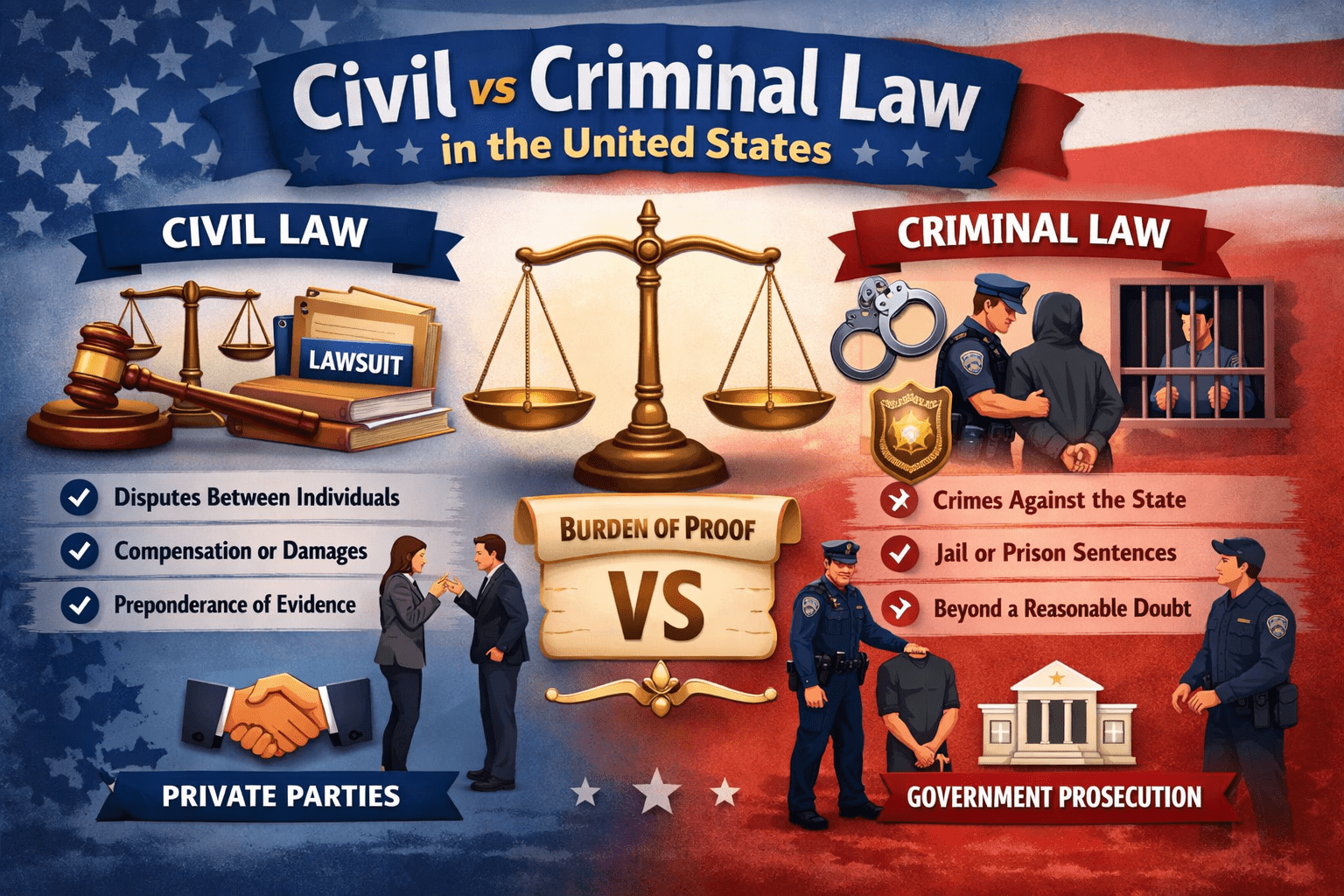
Civil law and criminal law are two separate parts of the U.S. legal system, but they serve very different purposes. Civil law is used to resolve disputes between individuals, businesses, or organizations, while criminal law deals with offenses that violate public laws and may result in prosecution by the government.
Knowing the difference is important because the legal process, the burden of proof, the rights of the parties involved, and the possible outcomes are not the same in every case. A civil lawsuit may result in financial compensation or a court order, whereas a criminal case can lead to penalties such as fines, probation, or imprisonment if the defendant is convicted.
Although both types of cases are decided in court, they follow different legal procedures and constitutional protections. This guide explains how civil and criminal law work in the United States, highlights the key differences between them, and uses practical examples to make the legal process easier to understand.
Key Differences Between Civil and Criminal Law
| Feature | Civil Law | Criminal Law |
|---|---|---|
| Purpose | Resolve disputes | Punish crimes |
| Filed By | Individual/Business | Government |
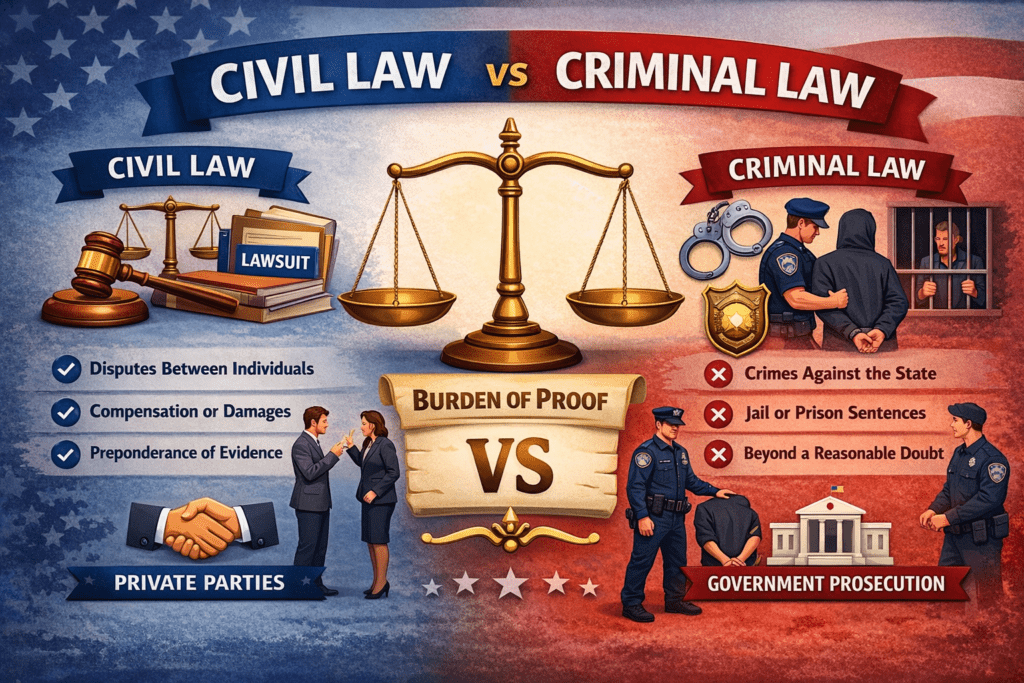
| Burden of Proof | Preponderance of the Evidence | Beyond a Reasonable Doubt |
| Outcome | Compensation | Fines, Probation, Jail |
| Example | Contract Dispute | Theft |
What Is Civil Law in the United States?
Civil law is the part of the U.S. legal system that resolves disputes between individuals, businesses, or organizations. Instead of punishing unlawful conduct, civil courts focus on resolving disagreements and providing legal remedies when someone claims to have suffered financial loss, property damage, or another type of legal harm.
The purpose of a civil case is to restore the injured party as fairly as possible. Depending on the circumstances, a court may award financial compensation, require a person to fulfill a legal obligation, or issue an order directing someone to stop or take a specific action. Unlike criminal cases, civil lawsuits do not result in jail or prison sentences.
Common examples of civil law cases include:
- Personal injury claims
- Breach of contract disputes
- Property and real estate disputes
- Insurance claims
- Employment disputes
- Consumer protection claims
In a civil lawsuit, the person or business filing the case is known as the plaintiff, while the party responding to the claim is called the defendant. The court reviews the evidence presented by both sides and decides whether the plaintiff has proven the legal claim under the applicable standard of proof.
What Is Criminal Law in the United States?
Criminal law is the part of the U.S. legal system that deals with conduct considered harmful to public safety or in violation of criminal statutes. Instead of resolving private disputes, criminal courts determine whether a person has committed a criminal offense and, if convicted, what legal penalties should apply.
In a criminal case, the government files charges against the accused because a crime is considered an offense against society as a whole. Depending on the jurisdiction, the case is typically brought in the name of The State or The United States. The accused person is known as the defendant, while prosecutors represent the government throughout the legal process.
Unlike civil cases, criminal cases require prosecutors to prove the defendant’s guilt beyond a reasonable doubt, which is the highest standard of proof in the U.S. legal system. This higher standard reflects the serious consequences that may result from a criminal conviction.
Common examples of criminal law cases include:
- Theft and fraud
- Assault and robbery
- Drug-related offenses
- Weapons offenses
- Homicide and other violent crimes
If a defendant is convicted, the court may impose penalties such as fines, probation, community supervision, or imprisonment, depending on the offense and the applicable federal or state law.
Real-Life Example of Civil and Criminal Law
A single incident can sometimes result in both a civil case and a criminal case because each serves a different legal purpose.
For example, if a driver is arrested for driving under the influence (DUI) after causing a serious traffic accident, the government may file criminal charges for violating state law. If the driver is convicted, the court may impose penalties such as fines, probation, license suspension, or imprisonment, depending on the circumstances of the case.
At the same time, the injured person may file a separate civil lawsuit seeking compensation for medical expenses, lost wages, property damage, and other financial losses. The civil court focuses on determining whether the injured party is entitled to compensation, while the criminal court decides whether the defendant violated the law and should face criminal penalties.
This example shows that one event can lead to two separate legal cases, each with its own legal process, standard of proof, and outcome.
Civil Compensation vs. Criminal Penalties: What’s the Difference?
One of the biggest differences between civil and criminal law is the outcome of the case. Civil courts focus on resolving disputes by providing a legal remedy to the injured party, while criminal courts focus on enforcing the law and imposing penalties when a defendant is found guilty.
In a civil case, the court may order the defendant to pay financial compensation, honor a legal agreement, return property, or comply with a court order. The purpose is to address the harm caused to the plaintiff rather than punish the defendant.
In a criminal case, the court may impose penalties such as fines, probation, community supervision, or imprisonment. These penalties are intended to hold the offender accountable, protect public safety, and discourage future criminal conduct. In some cases, the court may also order restitution to compensate the victim for financial losses.
Although both court systems can require a defendant to take responsibility for their actions, the primary goal of civil law is to resolve private disputes, while criminal law is intended to enforce public laws and protect society.
When Does Civil Law or Criminal Law Apply?
The type of legal case depends on the nature of the dispute or alleged offense. Civil law generally applies when a person or business seeks compensation for financial loss, property damage, or another private dispute. Criminal law applies when someone is accused of violating a law that protects public safety or public order, and the government decides to prosecute the case.
In some situations, the same incident can lead to both a civil case and a criminal case. For example, a drunk driving accident may result in criminal charges filed by the government as well as a civil lawsuit filed by the injured victim. Although both cases arise from the same event, they serve different legal purposes and follow different legal procedures.
FAQs
Is civil law less serious than criminal law?
Not necessarily. Civil cases do not usually result in jail or prison, but they can involve substantial financial damages, court orders, or other legal obligations. Depending on the case, a civil judgment may have significant financial and long-term legal consequences.
Can the same act result in both a civil case and a criminal case?
Yes. A single incident can lead to both civil and criminal proceedings. For example, a drunk driving accident may result in criminal charges filed by the government and a separate civil lawsuit filed by the injured party seeking financial compensation.
Do all civil cases go to trial?
No. Many civil disputes are resolved before trial through negotiation, mediation, or settlement. When the parties cannot reach an agreement, the case may proceed to a judge or jury for a final decision.
Who pays damages in a civil lawsuit?
If the court finds the defendant legally liable, the defendant may be ordered to pay financial compensation to the plaintiff. The amount depends on the evidence presented, the nature of the claim, and the court’s decision.
Does criminal law work the same way in every state?
No. Criminal laws, penalties, and court procedures vary from state to state. However, constitutional protections and many fundamental legal principles apply throughout the United States.
Can a civil dispute later become a criminal case?
Yes, in some situations. If evidence shows that a person committed a criminal offense, government authorities may decide to file criminal charges even if a related civil lawsuit already exists or has been filed.
Can someone go to jail in a civil case?
Generally, no. Civil cases usually involve financial compensation or court orders rather than incarceration. Jail is typically associated with criminal convictions, although courts may impose other legal consequences for failing to comply with certain court orders.
Which is harder to prove: civil law or criminal law?
Criminal cases are harder to prove because prosecutors must establish guilt beyond a reasonable doubt, which is the highest standard of proof in the U.S. legal system. Civil cases use a lower legal standard, commonly known as the preponderance of the evidence.
Conclusion
Civil law and criminal law play different but equally important roles in the U.S. legal system. Civil law helps resolve disputes between individuals, businesses, and organizations, while criminal law addresses conduct that violates public laws and may result in government prosecution.
Understanding the differences between these two legal systems makes it easier to recognize which legal process applies in a particular situation, what rights the parties have, and what outcomes may be expected. Whether a case involves a contract dispute, personal injury claim, theft, or another legal issue, knowing how civil and criminal law work can help individuals make informed decisions and better understand the legal process.
Because laws and court procedures may vary between states, it is always important to review the laws that apply in your jurisdiction or seek qualified legal guidance when necessary.