Why the Right to Remain Silent Matters in Real Life
The right to remain silent is one of the most powerful and misunderstood protections in the American legal system. Many people recognize the phrase from television shows or police dramas, yet far fewer understand how it works in real life, when it applies, and how to use it correctly. In the United States, this right is closely tied to police encounters, arrests, and courtroom proceedings—and using it properly can make a critical difference in the outcome of a legal situation.
At its core, the right to remain silent explained means that you cannot be forced to answer questions that may incriminate you. This protection exists to prevent coercion, protect fairness, and preserve constitutional balance between individuals and the government. Whether you are stopped during a traffic stop, questioned as a witness, or formally arrested, understanding what is the right to remain silent is essential for protecting yourself and your future.
This guide breaks down how the right to remain silent law works in everyday situations, with clear explanations, practical examples, and an honest discussion of its limits—so you can make informed, confident decisions if the moment ever arises.
In real life, most people don’t think about constitutional rights while going about their day. They think about them when something feels off—when a simple traffic stop turns tense, when a routine question feels uncomfortable, or when silence suddenly seems safer than explaining yourself. These moments often happen fast, without warning, and under pressure. That is usually when people realize how important it is to understand their rights before—not after—words are spoken.
The Constitutional Foundation of the Right to Remain Silent
The right to remain silent USA is rooted in the Fifth Amendment to the U.S. Constitution. The Fifth Amendment states that no person “shall be compelled in any criminal case to be a witness against himself.” This single sentence forms the backbone of the fifth amendment right to remain silent and applies across federal and state legal systems.
This protection was designed to prevent abusive interrogation tactics and forced confessions. Historically, courts recognized that pressured statements—especially those made without legal guidance—were unreliable and unfair. Over time, courts reinforced the principle that silence cannot automatically be treated as guilt.
In practical terms, this means the government bears the burden of proving a case. You are not required to help law enforcement or prosecutors build evidence against you. The right to remain silent explained is not about avoiding responsibility; it is about ensuring that justice is reached through lawful, ethical means.
What Are Miranda Rights and How They Connect to Silence
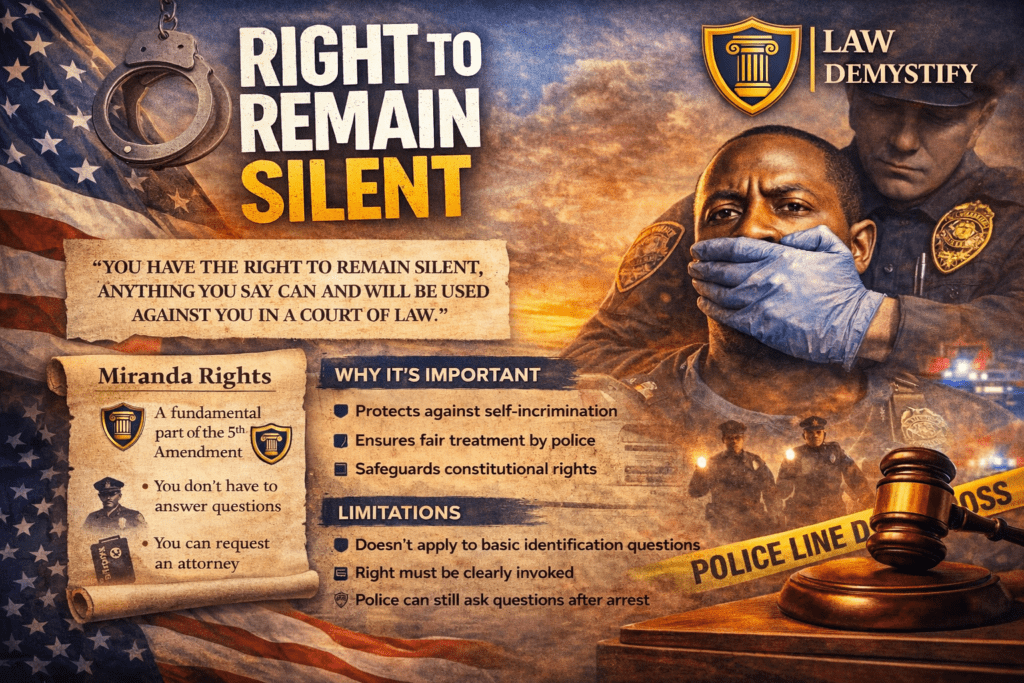
Most Americans first hear about silence through Miranda rights explained. Miranda rights come from a landmark Supreme Court decision requiring police to inform individuals of specific constitutional protections during custodial interrogation.
When people ask what are Miranda rights, they are usually referring to a standard warning that includes:
- The right to remain silent
- The warning that anything you say can be used against you
- The right to an attorney
The miranda warning right to remain silent applies when two conditions exist: you are in custody, and law enforcement is conducting interrogation. If both conditions are not present, officers may not be required to read Miranda rights—even though the underlying right still exists.
This distinction is critical. Many people mistakenly believe that silence only matters after Miranda warnings are given. In reality, the right to remain silent miranda is a procedural safeguard, not the source of the right itself.
When Does the Right to Remain Silent Apply?
A common question is when does the right to remain silent apply. The answer depends on the situation, but the protection exists more broadly than most people realize.
You may invoke silence during:
- Police questioning
- Custodial interrogation
- Arrests
- Court testimony that could be self-incriminating
Even before an arrest, can you remain silent during police questioning? Yes, but how you do so matters. Courts have consistently ruled that silence must be clearly asserted. Remaining quiet without stating your intent may not fully protect you.
During an arrest, the right to remain silent during arrest is especially important. Stress, confusion, and fear often lead people to speak impulsively. Unfortunately, even casual remarks can be misunderstood or misused later.
Understanding when silence applies—and how to invoke it properly—can prevent unnecessary legal complications.
Many people are surprised to learn that casual conversations with police can quickly become formal questioning. What feels like a friendly exchange can later be treated as a statement. People often speak out of nervousness, not guilt—trying to be cooperative or polite. Unfortunately, even harmless explanations can be misunderstood or taken out of context once written into a report.
How to Invoke the Right to Remain Silent Correctly
Knowing how to invoke the right to remain silent is just as important as knowing it exists. Courts require an unambiguous assertion. Simply staying quiet may not be enough.
Clear statements include:
- “I am invoking my right to remain silent.”
- “I do not wish to answer questions without a lawyer present.”
Once invoked, questioning must stop. Continuing to speak afterward can waive the protection. This is why legal professionals consistently stress clarity and consistency when asserting the right to remain silent law.
Importantly, invoking silence is not an admission of guilt. It is a constitutional safeguard designed to protect everyone—regardless of innocence or guilt.
In practice, invoking this right can feel uncomfortable. Silence can feel awkward, especially when authority is involved. Many people worry that staying quiet will make things worse. The reality is that the legal system is designed to work with evidence—not conversation under pressure. Choosing silence is not about confrontation; it is about protecting clarity when emotions are high.
Can Silence Be Used Against You?
Many people worry about can silence be used against you. In most criminal contexts, silence after invoking the Fifth Amendment cannot be used as evidence of guilt. Prosecutors are generally prohibited from suggesting that silence equals wrongdoing.
However, there are nuances. Pre-arrest silence, civil cases, and certain administrative proceedings may follow different rules. These exceptions to the right to remain silent are fact-specific and often misunderstood.
This is why blanket assumptions can be dangerous. While the right to remain silent explained offers strong protection, it is not absolute in every legal context. Understanding these boundaries is essential for making informed decisions.
Limits and Exceptions to the Right to Remain Silent
The limits of the right to remain silent are where confusion often arises. While the Fifth Amendment is powerful, it does not eliminate all obligations to speak.
Key right to remain silent exceptions include:
- Providing basic identifying information in many states
- Testifying under oath when immunity is granted
- Certain civil or regulatory proceedings
Additionally, voluntary statements made after invoking silence may still be admissible. Courts evaluate whether statements were truly voluntary or the result of improper pressure.
Understanding these limits helps prevent unintentional waiver of rights and reinforces why legal guidance is so valuable in high-stakes situations.
The Right to Remain Silent in Court Proceedings
The right to remain silent in court plays a different role than it does during police encounters. Defendants cannot be forced to testify at their own criminal trial. Judges instruct juries that they may not draw negative conclusions from a defendant’s choice not to testify.
This protection ensures fairness and prevents emotional or rhetorical pressure from influencing verdicts. The fifth amendment right to remain silent remains a cornerstone of courtroom justice, preserving the principle that the prosecution must prove its case independently.
At the same time, witnesses and defendants must navigate procedural rules carefully. Silence in court carries legal consequences that differ from street-level encounters, reinforcing the importance of understanding context.
Why This Right Still Matters Today
In an era of constant recording, digital evidence, and rapid police responses, the right to remain silent USA is more relevant than ever. Statements can be taken out of context, replayed, or interpreted in ways you never intended.
Exercising silence is not about distrust—it is about balance. The legal system is designed to function fairly when each party respects its role. The right to remain silent law protects individuals from being overwhelmed by authority and ensures that justice remains grounded in evidence, not pressure.
Real-World Police Encounters: How Silence Plays Out on the Street
Understanding the right to remain silent in theory is important—but how it unfolds during real police encounters is where most people struggle. Stress, authority, and uncertainty often lead individuals to talk when silence would be safer. Knowing how the law treats everyday encounters helps bridge that gap.
During a routine stop or investigation, officers may ask casual questions that feel harmless. In reality, these questions are often designed to gather statements. If you are wondering do you have to talk to police, the general answer is no—beyond basic identifying information required by law in many states. Politely declining to answer questions is lawful and protected.
However, silence should be deliberate and clear. Courts have emphasized that a person must affirmatively invoke the right to remain silent explained. Calmly stating your intention helps avoid confusion and preserves your protection if the interaction escalates.
Traffic Stops and Investigatory Detentions
Traffic stops are among the most common encounters where the right to remain silent USA becomes relevant. Officers may ask where you are going, whether you have been drinking, or if you know why you were stopped. While providing license, registration, and insurance is usually mandatory, answering investigative questions is not.
If you choose to remain silent, doing so respectfully matters. Statements like “I’m choosing not to answer questions” or “I’m invoking my right to remain silent” are appropriate and lawful. This approach protects you without escalating the situation.
Many drivers worry that silence will lead to harsher treatment. In practice, courts focus on evidence, not cooperation. The right to remain silent law exists precisely to ensure that citizens are not pressured into self-incrimination during routine encounters.
Real-world encounters rarely unfold like courtroom scenarios or television shows. People are often tired, stressed, or in a hurry. A simple question asked on the roadside can feel harmless, but later become significant. This is why legal professionals consistently emphasize understanding rights before a stressful encounter—not while standing in the middle of one.
Police Questioning vs. Custodial Interrogation
A critical distinction in silence cases is whether questioning is custodial. People often ask can police force you to talk. The answer depends on whether you are free to leave.
If you are not under arrest and are told you may leave, questioning is generally considered voluntary. You may still invoke the right to remain silent during interrogation, but Miranda warnings may not be required. If you are in custody and being questioned, Miranda protections apply, and officers must respect your assertion of silence.
Understanding this distinction helps explain why miranda rights explained are not always read immediately. The absence of a warning does not erase your rights—it simply reflects how courts categorize the interaction.
Common Mistakes People Make When Invoking Silence
Even well-intentioned people sometimes undermine their own protection. One frequent mistake is talking after initially invoking silence. Once you begin answering questions again, courts may view that as a waiver.
Another mistake is being ambiguous. Statements like “I think I should stay quiet” or “Maybe I need a lawyer” may not clearly invoke the fifth amendment right to remain silent. Courts look for clear, unmistakable language.
Finally, volunteering explanations or trying to “clear things up” often backfires. Silence is not rudeness; it is a constitutional right designed to protect you from misunderstandings and unintended admissions.
Can Silence Be Used Against You Later?
A persistent concern is what happens if you remain silent. In criminal cases, once the Fifth Amendment is invoked, prosecutors generally cannot argue that silence equals guilt. Judges routinely instruct juries that no negative inference may be drawn.
That said, can silence be used against you in other contexts? In civil cases or administrative hearings, the rules may differ. Silence might carry practical consequences, such as adverse inferences or procedural penalties, depending on the forum.
These exceptions to the right to remain silent do not weaken the constitutional protection in criminal law, but they do highlight why context matters. Silence is powerful, but it must be understood within the legal setting in which it is used.
The Right to Remain Silent During Arrest and Booking
During arrest, emotions run high and the risk of saying something harmful increases. The right to remain silent during arrest is especially important because statements made at this stage are often recorded and later scrutinized.
Even casual remarks—complaints, jokes, or explanations—can be introduced as evidence. Invoking silence early helps limit exposure. Importantly, officers may continue routine booking questions, such as name and date of birth. Answering these does not waive the broader right to remain silent explained.
Remaining calm and consistent during arrest protects your legal position while allowing the process to proceed without unnecessary conflict.
Silence in Court: Defendants, Witnesses, and Juries
The right to remain silent in court takes on a formal role. Criminal defendants cannot be compelled to testify, and choosing not to do so cannot legally be used against them. This principle is a cornerstone of American justice.
Witnesses, however, face different obligations. A witness may invoke the Fifth Amendment if testimony could be self-incriminating, but blanket silence is not always permitted. Courts balance the witness’s rights against the needs of justice.
For juries, silence must remain neutral. Judges instruct jurors that silence is not evidence. This reinforces the fundamental idea behind the right to remain silent USA: the burden of proof always rests with the government.
Is Remaining Silent Always Legal?
A frequent question is remaining silent always legal. In criminal investigations, invoking the Fifth Amendment is lawful and protected. However, there are narrow situations where silence may have consequences.
For example, refusing to comply with lawful orders unrelated to testimony—such as exiting a vehicle or providing identification where required—can lead to penalties. These situations are not about speech but about compliance with lawful procedures.
Understanding these boundaries helps ensure that silence is used effectively and lawfully, without unintentionally creating additional issues.
To better understand how constitutional protections work together, see our Legal Basics in the United States: A Beginner’s Guide.
Practical Guidance for Protecting Yourself
When deciding whether to speak, remember that the right to remain silent law exists to protect everyone—not just those accused of crimes. Exercising it calmly and respectfully preserves your rights without escalating tension.
Key principles to keep in mind:
- Be clear and direct when invoking silence
- Do not argue or explain your decision
- Remain consistent once silence is invoked
Using the right to remain silent explained in this way aligns with constitutional intent and reduces the risk of misunderstanding.
These are some of the most common questions people ask when they encounter this right in real life.
Frequently Asked Questions (FAQ)
Do you have to talk to police?
No. Beyond basic identifying information required by law, you generally do not have to answer investigative questions.
Can police force you to talk?
Police cannot force you to answer questions that may incriminate you if you invoke the Fifth Amendment.
What happens if you remain silent?
In criminal cases, your silence cannot legally be used as evidence of guilt once properly invoked.
Is remaining silent always legal?
In criminal contexts, yes. In civil or administrative settings, silence may have different consequences.
When does the right to remain silent apply?
It applies whenever your statements could be self-incriminating, including during questioning, arrest, and trial.
How do you invoke the right to remain silent?
State clearly that you are invoking your right and do not wish to answer questions without counsel.
Can silence be used against you in court?
In criminal trials, no. Judges instruct juries not to draw negative inferences from silence.
Most people who rely on this right never expected to need it. They are not criminals or legal experts—they are ordinary individuals caught in unexpected situations. Knowing how the law works ahead of time helps people stay composed, make fewer mistakes, and avoid decisions driven by fear or confusion.
Why This Right Deserves Respect
The right to remain silent is not about avoiding responsibility or obstructing justice. It is about fairness, balance, and protecting individuals from the immense power of the state. Used properly, it preserves the integrity of the legal process and safeguards constitutional values.
Understanding what is the right to remain silent, when it applies, and how to invoke it empowers individuals to navigate stressful legal situations with confidence. Whether you are a professional, a student, or simply an informed citizen, this knowledge strengthens your ability to protect yourself while respecting the rule of law.
Educational awareness—not fear—should guide decisions. The Constitution provides the framework; informed individuals give it life.