Understanding your constitutional protections during a police encounter is one of the most important parts of basic legal literacy in the United States. When people search for miranda rights explained, they are usually trying to answer one urgent question: “What are my rights if I am arrested or questioned by police?”
These rights exist to ensure fairness, prevent coercion, and guarantee that any statement used in court is voluntary and informed. For tenants, landlords, and everyday consumers, this knowledge matters because criminal allegations can affect housing, employment, credit, and financial stability.
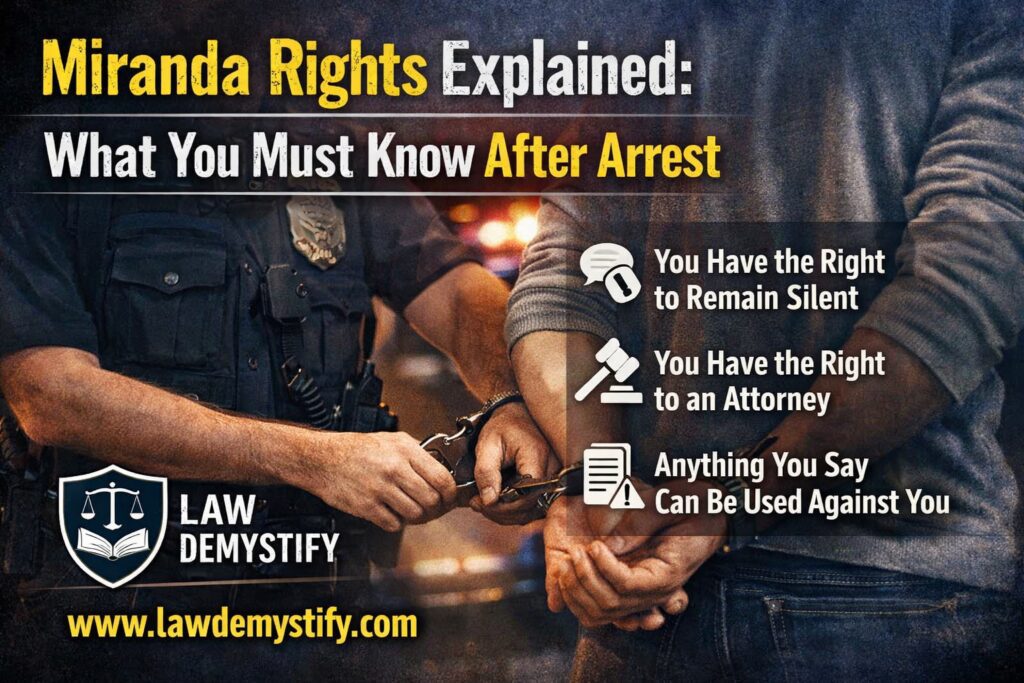
This guide provides a clear, structured explanation of Miranda rights explained, how they operate in real life, and what they do—and do not—protect. It is written for educational purposes only and does not provide legal advice.
What Are Miranda Rights?
In simple terms, Miranda rights are constitutional protections that must be communicated to a person before custodial police interrogation.
The phrase “what are miranda rights” refers to a warning that law enforcement officers must give when two conditions are met:
- The person is in custody, and
- The person is being interrogated.
The warning typically includes:
- The right to remain silent
- The statement that anything said can be used in court
- The right to an attorney
- The right to a court-appointed attorney if one cannot be afforded
These protections arise from the Fifth Amendment to the U.S. Constitution, which protects against compelled self-incrimination.
When people look for miranda rights explained, they are often surprised to learn that these rights are not required in every police interaction. The key legal trigger is custodial interrogation.
What Is the Miranda Warning Meaning?
The miranda warning meaning is rooted in a 1966 Supreme Court decision, Miranda v. Arizona. In that case, the Court held that statements made during custodial interrogation are not admissible unless the suspect was first informed of specific constitutional protections.
The purpose of the warning is to ensure that any confession or statement is voluntary and informed.
The warning does not create new rights. Instead, it reinforces existing fifth amendment rights, particularly the protection against being forced to testify against oneself.
In practical terms, the warning serves as a procedural safeguard. It ensures that:
- A person understands they can remain silent.
- A person understands they can request an attorney.
- Police cannot rely on statements obtained through coercion without proper notice.
When Are Miranda Rights Read?
A common search question is: when are miranda rights read?
The answer is clear: they must be read before custodial interrogation.
Custody does not necessarily mean formal arrest. A person is considered “in custody” when a reasonable person would not feel free to leave.
Interrogation refers to questioning or actions by police that are likely to elicit an incriminating response.
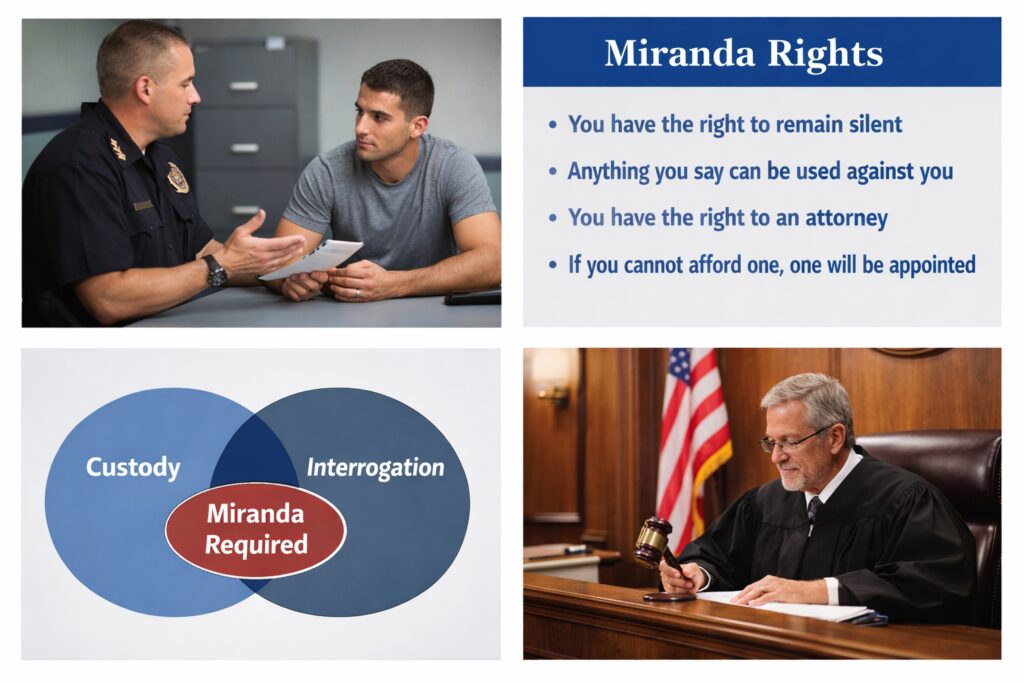
If both elements are present, the warning must be provided before questioning begins.
If police ask general, voluntary questions during a casual encounter where a person is free to leave, the warning is not required.
This distinction is critical in understanding miranda rights explained accurately.
Do Miranda Rights Apply Before Arrest?
Many people ask: do miranda rights apply before arrest?
They can—but only if the situation qualifies as custodial interrogation.
A person does not have to be formally arrested for Miranda protections to apply. However, if someone voluntarily speaks with police and is not in custody, the warning is generally not required.
For example:
- A landlord speaking with police at the property about a tenant dispute may not be in custody.
- A tenant voluntarily answering questions during a non-coercive conversation may not be in custody.
In these cases, statements can potentially be used even if no warning was given.
Do Miranda Rights Apply During Traffic Stops?
Most routine traffic stops do not require Miranda warnings because they are generally considered temporary investigative detentions rather than full custodial interrogation.
However, if a traffic stop escalates into formal custody and interrogation—for example, after an arrest for DUI—Miranda protections may apply before questioning begins.
Understanding this distinction prevents the common misconception that police must read rights during every roadside stop.
What Does the Right to Remain Silent Mean?
When people search “what does the right to remain silent mean,” they are asking about the core protection behind Miranda.
The right to remain silent means that you are not required to answer questions that may incriminate you.
It does not mean you can ignore lawful identification requests or court orders. It specifically protects against compelled testimonial self-incrimination.
In practice, asserting this right must be clear. Simply staying silent is not always enough. Courts often require an explicit statement such as:
“I am invoking my right to remain silent.”
Understanding this nuance is a key part of properly understanding miranda rights explained.
Can You Waive Your Miranda Rights?
After police read the warning, an individual may choose to waive their rights and speak with investigators. A waiver must generally be knowing, voluntary, and intelligent.
This means:
- The person understood the warning.
- The person was not coerced.
- The person chose to speak freely.
However, many people do not realize that once they begin speaking, their statements can be used against them—even if they later regret the conversation.
In real life, this often happens when someone believes they can “clear things up quickly.” Emotional situations, especially in domestic disputes or financial investigations, can lead to statements made without fully understanding long-term consequences.
A person may stop answering questions at any time and request an attorney. Once counsel is requested, interrogation must stop.
Can Police Question You Without Miranda?
Another frequent question is: can police question you without miranda?
Yes, in certain situations.
Miranda warnings are only required before custodial interrogation. Police may question individuals without providing warnings if:
- The person is not in custody.
- The questioning is routine (such as booking information).
- There is an immediate public safety concern.
If a person voluntarily speaks without being in custody, those statements may still be admissible.
This becomes especially important when individuals assume that any conversation with law enforcement automatically triggers Miranda protections. That assumption is incorrect.
What Happens If Miranda Rights Are Not Read?
The question what happens if miranda rights are not read often causes confusion.
Failure to provide a Miranda warning does not automatically dismiss a case. Instead, the primary consequence is that statements obtained during custodial interrogation may be excluded from evidence. This is known as suppression.
Later Supreme Court decisions have clarified that Miranda is a procedural safeguard rather than a standalone constitutional right, meaning the remedy for violations is generally exclusion of statements—not dismissal of charges.
Has the Supreme Court Changed Miranda Over Time?
Over the years, the Supreme Court has refined how Miranda protections operate. In Dickerson v. United States (2000), the Court reaffirmed that Miranda warnings are constitutionally required and cannot be eliminated by federal statute.
However, in more recent decisions, the Court clarified that Miranda violations generally result in exclusion of statements—not automatic civil liability or dismissal of charges.
These rulings confirm two key principles:
- Miranda remains binding constitutional law.
- The remedy for violations is typically suppression of statements, not case termination.
However:
- Physical evidence discovered independently may still be admissible.
- Statements made outside custodial interrogation may still be admissible.
- Charges do not disappear solely because the warning was not read.
This distinction is critical for anyone trying to understand miranda rights explained accurately and without misconceptions.
Miranda Rights After Arrest: What Changes?
The phrase miranda rights after arrest often implies that arrest automatically triggers the warning. That is not entirely correct.
Arrest often creates custody. But Miranda warnings are required only if interrogation follows.
If someone is arrested and transported without questioning, no warning is required at that moment.
If questioning begins while the individual is in custody, the warning must precede it.
In practical terms, this usually means that the warning is read shortly after arrest, but not always immediately at the moment handcuffs are applied.
How This Works in Real Life
Understanding miranda rights explained requires moving beyond textbook definitions.
In practice, this usually means:
- A tenant accused of property damage may be questioned.
- A landlord accused of fraud or financial misconduct may be interviewed.
- A consumer accused of financial wrongdoing may speak with investigators.
This becomes especially important when statements affect housing rights, lease agreements, or financial records.
For example:
A landlord under investigation for alleged misappropriation of security deposits may voluntarily speak with police before any formal custody occurs. If the landlord is not in custody, Miranda warnings are not required. Statements made during that voluntary conversation could potentially be used later.
Similarly, a tenant arrested after a domestic dispute may be read their rights before formal questioning at the station.
These scenarios show why understanding the conditions that trigger Miranda is more important than memorizing the words of the warning itself.
Federal Authority vs State Authority
Miranda rights originate from the U.S. Constitution and Supreme Court interpretation. This makes them federal constitutional protections.
However, states may implement additional procedural protections.
For example:
- Some states impose stricter recording requirements during interrogations.
- Some states require additional juvenile safeguards.
- Some states provide expanded protections in custodial settings.
State-level criminal procedure rules may vary in terms of timelines, documentation, and enforcement mechanisms.
While the constitutional baseline remains uniform nationwide, the application details can differ.
Understanding this federal-state balance is essential when examining miranda rights explained within specific jurisdictions.
How Miranda Interacts With Fifth Amendment Rights
The foundation of Miranda protections lies in the fifth amendment rights provision that no person “shall be compelled in any criminal case to be a witness against himself.”
Miranda warnings are not the source of the right—they are the enforcement mechanism.
Without warnings, custodial interrogation risks undermining the constitutional protection against compelled testimony.
This structure ensures:
- Voluntary statements are admissible.
- Coerced or uninformed statements are restricted.
- Courts maintain oversight of interrogation practices.
The constitutional framework protects not only individuals accused of serious crimes but also ordinary citizens entangled in disputes with potential criminal consequences.
What Happens After You Ask for a Lawyer?
If a person clearly requests an attorney during custodial interrogation, police must stop questioning until counsel is present.
This protection prevents law enforcement from pressuring someone after they have asked for legal assistance.
In practice, requesting an attorney is often one of the most powerful ways to protect constitutional rights. It does not imply guilt. It simply ensures that questioning proceeds within legal boundaries.
Courts take this protection seriously. If police continue questioning after a clear request for counsel, statements may be suppressed.
Why People Often Waive Their Rights
In real-world situations, many individuals waive their Miranda rights because they believe cooperation will quickly resolve the issue. Others feel intimidated, confused, or pressured to explain themselves immediately.
However, once a statement is made, it cannot easily be undone. Even minor inconsistencies can later be interpreted negatively. This is why understanding rights before a stressful encounter occurs is often more important than trying to remember them in the moment.
Common Mistakes People Make About Miranda Rights
Misunderstanding Miranda protections can affect legal outcomes. Some of the most common mistakes include:
- Assuming Miranda applies to every police conversation.
- Believing failure to read rights automatically ends a case.
- Thinking silence alone is always sufficient to invoke rights.
- Assuming private employers or landlords must give Miranda warnings.
These misunderstandings affect both tenants and landlords.
For instance, a property manager investigating employee theft is not required to give Miranda warnings. Miranda applies to government actors, not private individuals.
Confusing constitutional protections with private disputes can lead to serious strategic errors.
How Miranda Issues Can Affect Housing and Financial Stability
Criminal allegations often intersect with housing and consumer matters.
Arrests can lead to:
- Lease termination proceedings.
- Housing application denials.
- Employment loss.
- Credit consequences.
Understanding miranda rights explained helps individuals make informed decisions during questioning that may affect broader aspects of their lives.
For example:
A tenant accused of fraud related to rental assistance programs may face both criminal investigation and eviction proceedings. Statements made during interrogation could impact both matters.
Similarly, a landlord accused of discriminatory practices may face criminal and civil exposure.
The interaction between criminal procedure and housing stability makes constitutional literacy particularly important.
Lawful vs Unlawful Police Practices
Miranda does not prohibit questioning. It regulates how questioning occurs in custodial settings.
Lawful practices include:
- Advising individuals of rights before interrogation.
- Respecting invocation of the right to remain silent.
- Ceasing questioning after a request for counsel.
Unlawful practices may include:
- Continuing interrogation after invocation.
- Coercive or deceptive tactics that undermine voluntariness.
- Ignoring clear requests for counsel.
When courts evaluate violations, they examine the totality of circumstances.
Understanding these boundaries is central to a complete and accurate explanation of miranda rights explained.
The Role of the Courts in Enforcing Miranda
Judges determine whether statements were obtained lawfully.
If a defendant challenges admissibility, courts conduct hearings to assess:
- Whether custody existed.
- Whether interrogation occurred.
- Whether warnings were provided.
- Whether rights were invoked.
- Whether statements were voluntary.
This judicial oversight is the enforcement mechanism behind the doctrine.
Without judicial review, the protections would lack meaningful effect.
Frequently Asked Questions
Do police always have to read Miranda rights during an arrest?
No. Miranda warnings are required only before custodial interrogation. An arrest alone does not automatically require the warning.
If Miranda rights are not read, is the case dismissed?
Not automatically. The primary consequence is potential suppression of statements, not dismissal of charges.
Can I change my mind after speaking to police?
Yes. A person may invoke the right to remain silent or request an attorney at any point during custodial interrogation.
Are Miranda rights the same in every state?
The constitutional baseline is the same nationwide, but states may impose additional procedural safeguards.
Do Miranda rights apply to private security or landlords?
No. Miranda protections apply to government actors, not private individuals.
Can silence be used against someone in court?
In certain circumstances, silence after arrest and after receiving warnings cannot be used against a defendant. However, pre-arrest silence may be treated differently depending on jurisdiction.
Are juveniles treated differently under Miranda?
Yes. Courts often apply additional scrutiny when evaluating whether minors understood their rights and voluntarily waived them.
Conclusion
In real life, police encounters rarely feel calm or orderly. They often happen unexpectedly—during a traffic stop, at your home, or in the middle of a stressful dispute. In those moments, emotions run high and decisions are made quickly.
Understanding how Miranda rights actually work does not mean assuming guilt. It means understanding constitutional protections designed to ensure fairness. Whether someone ultimately faces charges or not, knowing when to speak and when to request counsel can have lasting legal consequences.