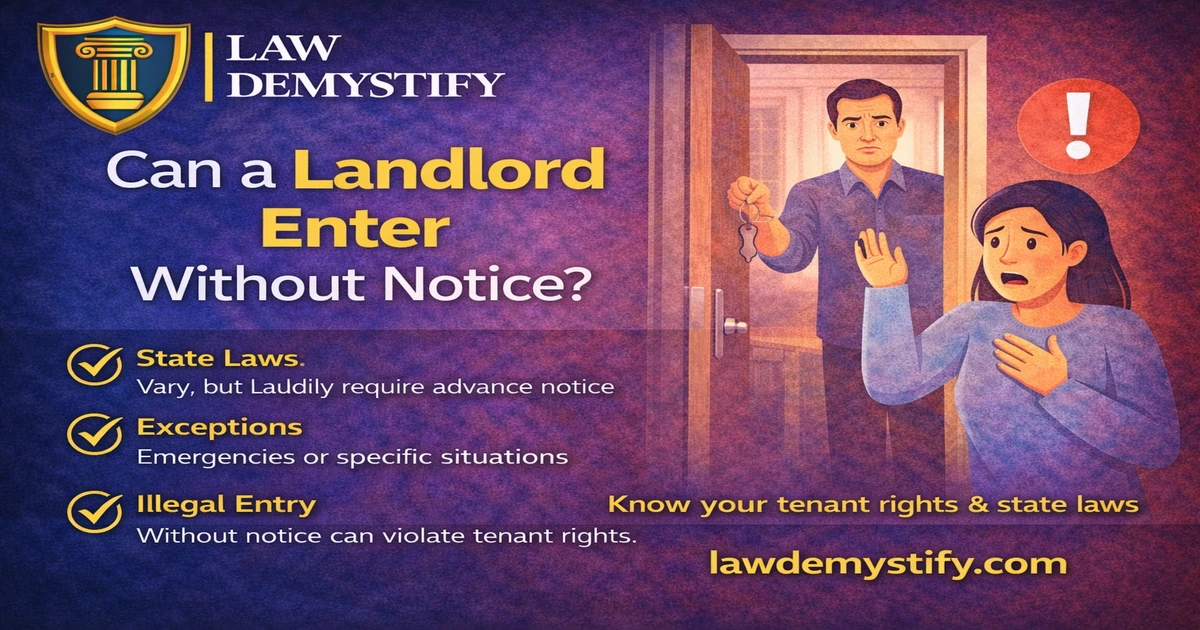
Questions about whether can a landlord enter without notice come up more often than almost any other landlord-tenant issue in the United States. Tenants often discover the issue the hard way—by coming home to find someone has entered their apartment without warning.
At its core, the issue of landlord entry without notice sits at the intersection of property rights and personal privacy. A rental unit may belong to the landlord, but during the lease term it is also the tenant’s home. U.S. law recognizes this dual reality by limiting when, why, and how a landlord may enter, while still preserving access for legitimate purposes.
This guide explains landlord right of entry USA rules in plain English. It walks through the legal foundation, notice requirements, emergency exceptions, and how entry laws vary by state. It also explains what happens when a landlord crosses the line, and what both tenants and landlords can do to stay compliant.
Federal Law vs State Control Over Landlord Entry
There is no single federal statute that comprehensively answers the question can a landlord enter without notice. Federal housing laws focus on discrimination, habitability standards in federally assisted housing, and consumer protections, but they do not set day-to-day entry rules for private rentals.
As a result, landlord entry laws USA are almost entirely controlled by state law. Every state recognizes some version of a tenant’s right to privacy and quiet enjoyment, but the details—how much notice must be given, what counts as an emergency, and what penalties apply—are set at the state level.
This state-driven structure explains why landlord entry laws by state matter so much. Conduct that is lawful in one jurisdiction may be unlawful just across state lines.
The Legal Foundation: Tenant Privacy and Quiet Enjoyment
To understand landlord entry explained, it helps to start with the concept of quiet enjoyment. Nearly every residential lease, whether written or implied by law, includes a covenant that the tenant will be able to use the property without unreasonable interference.
Under tenant privacy rights USA, this does not mean a landlord loses all access rights. It means access must be reasonable, purposeful, and consistent with state law. Random, frequent, or intrusive entry can violate this right, even if the landlord owns the property.
Courts routinely emphasize that quiet enjoyment is not about silence; it is about control over one’s living space. Judges frequently hear cases where landlords insist they “meant no harm,” but still rule in favor of tenants because notice rules were ignored.
General Rule: Notice Is Required for Non-Emergency Entry
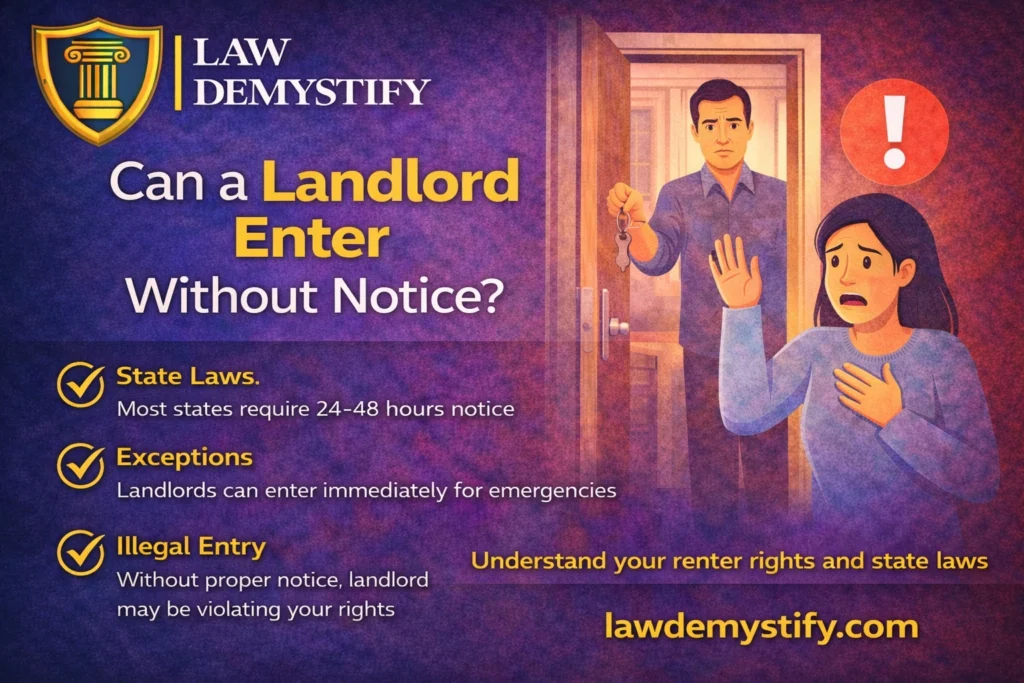
In most states, the default answer to can a landlord enter without notice is no—at least not for routine, non-emergency reasons. Activities such as inspections, repairs, showing the unit to prospective tenants or buyers, and maintenance almost always require advance notice.
The amount of notice varies, but common standards include 24 hours or “reasonable notice.” Some states define reasonable notice by statute; others leave it to courts to interpret based on circumstances.
In practice, many landlords assume short or last-minute notice is acceptable if the tenant is not home. Courts generally reject this assumption and focus on whether notice complied strictly with state law, not whether inconvenience was intended.
In real life, disputes often arise during routine situations—maintenance checks, repair follow-ups, or showing the unit to new tenants. What feels like a normal business task to a landlord can feel like a privacy violation to a tenant if proper notice is missing.
The purpose of landlord notice to enter rules is not to block access, but to respect the tenant’s daily life. Notice allows tenants to be present if they wish, secure pets, and prepare for entry.
How Much Notice Must a Landlord Give?
One of the most searched questions in this area is how much notice must a landlord give. The answer depends on state law, but patterns exist.
Many states specify a minimum of 24 hours’ notice for non-emergency entry. Others require 48 hours. A smaller number use flexible language such as “reasonable notice,” which courts often interpret as at least one day unless circumstances justify less.
Notice requirements often include not just timing, but method. Some states require written notice. Others allow verbal, electronic, or posted notice if it clearly informs the tenant of the intended entry.
Failure to comply with landlord entry notice requirements can turn an otherwise lawful entry into an illegal one.
Legitimate Reasons for Landlord Entry
Even with notice, a landlord’s right of entry is not unlimited. Landlord right of entry USA statutes usually list acceptable purposes for entry. Common lawful reasons include necessary repairs, routine inspections, responding to tenant requests, and showing the unit after proper notice.
Courts generally look at whether the entry served a legitimate property-related purpose. Entry for harassment, intimidation, or curiosity is not protected, even if notice was given.
This distinction matters in disputes. A landlord who enters repeatedly for trivial reasons may still violate tenant rights landlord entry protections.
Emergency Entry: When Notice Is Not Required
One of the most important exceptions under emergency landlord entry rules involves true emergencies. In nearly every state, a landlord may enter without notice when immediate access is necessary to prevent harm to people or property.
Common examples include fires, gas leaks, flooding, or situations where a tenant is believed to be in danger. In these cases, the law prioritizes safety over privacy.
However, the emergency exception is narrow. Courts closely examine whether an actual emergency existed. For example, a leaking pipe or gas smell is typically considered an emergency, while a planned inspection or cosmetic repair is not—even if labeled urgent by the landlord.
When Can a Landlord Enter Without Notice?
Outside of emergencies, the situations where when can landlord enter without notice apply are limited. Some states allow entry without notice if the tenant has abandoned the unit. Others allow it if the lease explicitly permits certain types of access, though even then courts often require reasonableness.
Importantly, convenience alone is never a valid reason. A landlord cannot enter without notice simply because it is easier or faster.
Understanding these limits is critical for avoiding claims of landlord harassment entry, which can arise from repeated or unjustified access.
Entry While the Tenant Is Not Home
Another common concern is can a landlord enter while you are not home. In most states, the answer is yes—but only if proper notice was given and the entry is for a lawful purpose.
The tenant’s absence does not eliminate privacy rights. Notice requirements still apply. If a landlord enters without notice while a tenant is away, it is often treated more seriously because the tenant had no opportunity to observe or object.
Courts frequently view unannounced entry into an empty unit as especially intrusive unless justified by an emergency.
Entering Without Permission vs Without Notice
It is important to distinguish landlord entering apartment without permission from entry without notice. Permission can be implied through the lease and state law. Notice, however, is procedural.
A landlord may have legal permission to enter for repairs, but still act unlawfully by failing to give notice. This distinction is central to many landlord entry explained disputes that often arise.
Tenants often assume any entry without explicit consent is illegal. In reality, the legality turns on compliance with statutory notice rules and purpose limitations.
State-by-State Variations in Entry Laws
Because landlord entry laws vary by state, national guidance must be applied carefully. Some states codify detailed entry statutes. Others rely on common law principles supplemented by housing codes.
For example, states like California and New York specify notice periods and permissible entry times. Other states allow more flexibility but still enforce the tenant’s right to quiet enjoyment through case law.
Understanding state landlord right of entry laws is particularly important for landlords operating in multiple jurisdictions, as compliance practices cannot be uniform nationwide.
Entry Timing and Reasonableness
Beyond notice, many states regulate the timing of entry. Entry late at night or very early in the morning may be deemed unreasonable, even with notice. Most statutes reference “normal business hours” or similar language.
Reasonableness is often assessed contextually. An urgent repair may justify early entry; a routine inspection may not. Courts weigh the landlord’s need against the tenant’s disruption.
Repeated or Excessive Entry as Harassment
Even lawful entry can become unlawful if it is excessive. Repeated inspections, frequent showings, or unnecessary visits may rise to the level of landlord harassment entry.
Courts evaluate patterns of behavior. One isolated incident may not violate the law, but repeated interference can support claims under tenant privacy rights USA protections.
Tenants often describe repeated entry as stressful and unsettling, particularly when it happens while they are at work or asleep. This emotional impact is one reason courts take repeated entry claims seriously, even when no property damage occurs.
Tenants experiencing repeated entry often report feeling intimidated or unable to enjoy their home, which is precisely what quiet enjoyment laws are designed to prevent.
What Is Considered Illegal Landlord Entry?
Understanding what is illegal landlord entry requires looking at both substance and procedure. Entry without required notice, entry for an improper purpose, entry at unreasonable times, and entry using deception can all be illegal.
Illegal entry does not require physical damage or theft. The violation itself is the intrusion. In some states, even a single unlawful entry can support statutory damages.
Tenant Remedies for Unauthorized Entry
When a landlord violates entry rules, tenant rights landlord entry protections may allow several remedies. Depending on the state, tenants may seek injunctive relief, monetary damages, or lease termination in extreme cases.
Documentation is critical. Keeping records of dates, times, notices, and communications often determines whether a claim succeeds.
Tenants are generally encouraged to raise concerns in writing first, giving the landlord an opportunity to correct behavior before escalating disputes.
Landlord Compliance Responsibilities
For landlords, understanding landlord entry laws USA is not optional. Courts rarely excuse violations based on ignorance. Compliance requires knowing state-specific notice rules, respecting tenant schedules, and limiting entry to legitimate purposes.
Good practices include providing written notice well in advance, clearly stating the reason for entry, and keeping a log of access events. These steps not only protect tenants but also reduce legal risk.
Lease Clauses and Entry Rights
Lease agreements often address entry, but they cannot override state law. Clauses that attempt to waive notice requirements or allow unrestricted access are frequently unenforceable.
However, clear lease language can clarify expectations. For example, specifying how notice will be delivered or identifying typical maintenance windows can reduce misunderstandings without violating landlord right of entry USA rules.
Entry After Notice Refusal by Tenant
Tenants sometimes attempt to deny entry even after proper notice. State law generally does not allow tenants to unreasonably withhold access for lawful purposes.
In such cases, landlords are typically required to seek court intervention rather than forcing entry. Self-help measures can quickly turn a lawful situation into an illegal one.
Special Rules for Repairs and Inspections
Repairs and inspections are among the most common reasons for entry disputes. While landlords have a duty to maintain habitable conditions, they must still follow notice rules unless an emergency exists.
Failure to balance these duties can lead to claims from either side—tenants alleging illegal entry, or landlords alleging denial of access.
The Role of Local Ordinances
In some cities, local ordinances supplement state law. These rules may impose stricter notice requirements or additional tenant protections. Landlords must comply with both state and local rules where applicable.
Ignoring local variations can undermine otherwise lawful practices under landlord entry laws by state.
Practical Scenarios and Legal Application
Consider a landlord who gives 24 hours’ notice to inspect smoke detectors and enters at a reasonable time. In most states, this is lawful. Contrast that with a landlord who enters unannounced to “check on things” while the tenant is at work. That second scenario often violates landlord entry without notice rules.
Real-world outcomes depend on documentation, purpose, and compliance with statutory procedures.
FAQs About Landlord Entry and Notice
Is a landlord allowed to enter the unit if the tenant is on vacation?
If proper notice was given and the purpose is lawful, entry may be permitted even if the tenant is away.
Does posting a notice on the door count as legal notice?
That depends on state law. Some states allow it; others require delivery by specific methods.
Can a landlord enter just to take photos?
Only if the entry serves a legitimate purpose and complies with notice requirements.
Are landlords allowed to enter monthly for inspections?
Frequent inspections may be considered unreasonable and could violate quiet enjoyment protections.
What should a tenant do after an unauthorized entry?
Document the incident, notify the landlord in writing, and review applicable state law remedies.
Can a landlord enter to show the unit before the lease ends?
Yes, in many states, but only with proper notice and at reasonable times.
Is changing the locks after illegal entry allowed?
Tenants generally cannot change locks without permission, even after unlawful entry, unless state law explicitly allows it.
Final Perspective on Landlord Entry Laws
Understanding whether can a landlord enter without notice requires careful attention to state law, lease terms, and the specific circumstances of entry. These rules are designed to balance ownership rights with the fundamental principle that a rented home is still a private living space.
When both landlords and tenants understand landlord entry explained standards and follow them consistently, disputes become less common and more predictable. Education and compliance remain the most effective tools for protecting rights on both sides of the rental relationship.