The legal distinction between an independent contractor vs employee is critical for both workers and businesses in the United States. This classification affects taxes, wages, benefits, legal protections, and long-term financial security. Yet many people only realize there may be a problem when something feels off—such as unexpected tax bills, missing benefits, or being treated like an employee while paid as a contractor.
From freelancers and gig workers to startups and established companies, confusion around independent contractor classification is common. Misclassification can lead to unpaid taxes, denied benefits, back wages, and legal penalties—sometimes discovered years later through audits, lawsuits, or tax notices. This guide explains the difference between independent contractor and employee under U.S. law in clear, practical terms, using situations many workers and businesses actually face.
Worker classification problems usually do not happen alone. In real life, people labeled as independent contractors often later face related issues like unpaid wages, missing benefits, tax surprises, or sudden job loss. Understanding the difference between an independent contractor vs employee as part of the broader legal basics in the United States helps workers see how employee rights, pay rules, and termination laws are often connected—and why small classification mistakes can turn into bigger problems over time.
This article is educational in nature and designed to help readers understand how U.S. worker classification rules generally work. For many workers, questions about classification do not come up until a real financial or workplace issue forces them to look more closely.
What Is the Difference Between an Independent Contractor and an Employee?
At its core, the difference between independent contractor and employee comes down to control, independence, and economic relationship. U.S. law does not rely on job titles alone. Instead, federal and state agencies look at how the working relationship functions day to day, not just how it is described on paper.
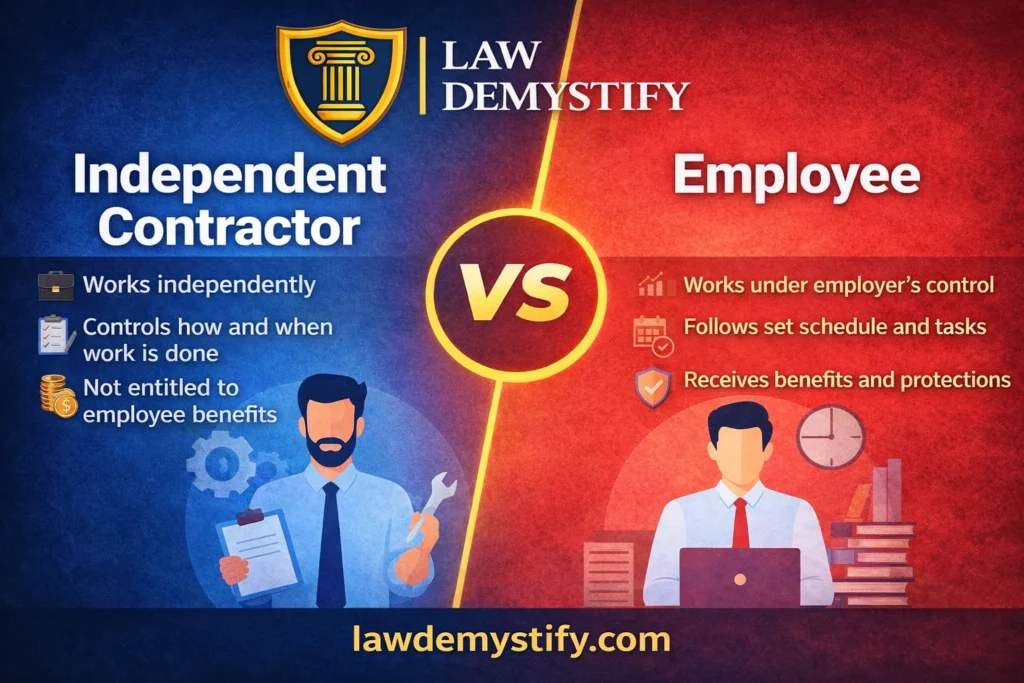
An employee is typically integrated into a company’s operations. They follow schedules set by the employer, use company tools, and perform ongoing work that supports the business’s core activities. In contrast, an independent contractor usually operates a separate business, controls how work is done, and offers services to multiple clients.
This employee vs independent contractor distinction determines who pays taxes, who receives workplace protections, and who bears legal responsibility. Simply labeling a worker as a contractor does not make it legally valid.
Why Worker Classification Matters Under U.S. Law
Worker classification is not a technical formality. It directly impacts wages, taxes, benefits, and legal rights. Under worker classification laws, employees receive protections that independent contractors do not.
Employees are generally entitled to minimum wage, overtime pay, unemployment insurance, and workers’ compensation. Independent contractors, on the other hand, negotiate their own rates and are responsible for their own insurance and tax payments.
From an employer’s perspective, proper classification affects payroll taxes, compliance obligations, and legal exposure. Employee misclassification can trigger audits, penalties, and lawsuits. For workers, being misclassified as an independent contractor can mean losing thousands of dollars in benefits and protections.
How U.S. Law Determines Worker Status
There is no single universal rule for worker classification in the United States. Different agencies apply different standards depending on the context. However, all tests focus on the reality of the working relationship rather than contractual labels.
Federal agencies like the IRS and the Department of Labor evaluate factors related to control, financial independence, and the nature of the relationship. States may apply additional or stricter standards under their own worker classification rules USA.
Understanding these frameworks helps explain why classification disputes are so common—and why contracts alone are not enough to decide status.
The IRS Independent Contractor Test Explained
The IRS uses what is commonly known as the IRS independent contractor test, which focuses on three broad categories. This framework is central to resolving employee vs contractor IRS test disputes.
Behavioral control looks at whether the business directs how the work is done. Financial control examines how the worker is paid and whether they can realize profit or loss. Relationship factors consider benefits, contract terms, and the permanence of the relationship.
Together, these elements are often called the behavioral financial relationship test. No single factor is decisive. The IRS evaluates the full picture to determine whether a worker is truly independent or functions like an employee.
Control and Independence: The Core Legal Issue
Control is one of the most important factors in independent contractor vs employee USA cases. When a business dictates work hours, methods, training, and supervision, the relationship often resembles employment.
Independent contractors typically decide when, where, and how they perform services. They may hire assistants, use their own equipment, and work for multiple clients simultaneously. Employees usually cannot.
Courts and agencies consistently emphasize substance over form. Even if a contract says “independent contractor,” excessive control can override that label under worker classification laws.
Financial Risk and Opportunity Differences
Another major distinction in the employee vs independent contractor analysis is financial risk. Employees are paid a regular wage or salary and are insulated from business losses. Independent contractors, by contrast, face both risk and opportunity.
Contractors may invest in tools, market their services, negotiate fees, and incur unreimbursed expenses. Their income can fluctuate based on performance and demand. Employees rarely face this level of financial exposure.
This financial independence is a key reason why independent contractor misclassification claims often focus on reimbursement policies, payment structures, and exclusivity requirements.
Taxes: Independent Contractor vs Employee Obligations
Tax treatment is one of the most noticeable differences in the independent contractor vs employee relationship. Employees receive a W-2 form, and their employer withholds income taxes, Social Security, and Medicare contributions.
Independent contractors receive a 1099 form and are responsible for paying their own taxes. This includes self-employment tax, estimated quarterly payments, and full Social Security and Medicare contributions. These tax differences contractor vs employee can significantly affect take-home income.
Many workers only realize they may have been misclassified when tax season arrives and they suddenly owe thousands of dollars in self-employment taxes they were not expecting.
1099 vs W2 Difference: What It Really Means
The 1099 vs W2 difference goes far beyond paperwork. A W-2 signals employee status and access to labor law protections. A 1099 indicates independent contractor status and limited legal safeguards.
However, receiving a 1099 does not automatically make someone a contractor under the law. If the working relationship meets the criteria for employment, agencies may still find employee misclassification, regardless of tax forms issued.
This distinction is central to many disputes involving independent contractor classification, especially in gig economy and remote work arrangements.
Employee Benefits vs Contractor Flexibility
When comparing employee benefits vs contractor arrangements, the trade-offs become clear. Employees often receive health insurance, paid leave, retirement plans, and legal protections against discrimination and wrongful termination.
Independent contractors gain flexibility and autonomy but generally forgo these benefits. They must secure their own insurance and retirement savings. This balance between security and independence is a defining feature of the employee rights vs contractor rights debate.
Problems arise when workers lose benefits without gaining true independence—one of the hallmarks of misclassification.
Common Industries Where Misclassification Occurs
Independent contractor misclassification frequently appears in industries that rely on flexible labor. Construction, trucking, healthcare staffing, delivery services, and digital platforms are common examples.
In these sectors, businesses may attempt to reduce costs by labeling workers as contractors while maintaining employee-like control. This practice has led to increased enforcement and litigation under worker classification laws.
Workers in these fields often ask, “Am I an independent contractor or employee?” The answer depends on the actual working conditions, not industry norms.
Real-World Example of a Classification Dispute
Consider a graphic designer who works full-time for one company, follows a fixed schedule, uses company software, and must obtain approval for time off. Even if paid via 1099, these factors may support employee status under the independent contractor test USA.
By contrast, a designer who serves multiple clients, sets their own hours, negotiates fees, and uses personal tools is more likely a true contractor. These examples illustrate how facts, not labels, drive classification outcomes.
Situations like this are common in creative, tech, and remote roles, where flexibility is promised but control remains tightly with the company.
Why Misclassification Creates Legal Risk for Employers
From a business standpoint, employee misclassification creates serious legal exposure. Penalties may include back taxes, unpaid overtime, benefit contributions, and government fines.
Agencies may audit payroll records, contracts, and work practices to assess compliance. Civil lawsuits can also arise, particularly in class or collective actions. Understanding worker classification rules USA helps businesses avoid costly disputes.
Proper classification is not just a compliance issue—it is a risk management strategy.
Employee Rights vs Contractor Rights Under U.S. Law
One of the most significant consequences in the independent contractor vs employee distinction is the difference in legal rights. Employees are protected by a wide range of federal and state labor laws, while independent contractors operate largely outside these frameworks.
Employees are generally covered by minimum wage laws, overtime rules, anti-discrimination statutes, family and medical leave protections, and workplace safety requirements. These employee rights vs contractor rights exist because employees are considered economically dependent on their employer.
Independent contractors, by contrast, are treated as separate businesses. They typically do not receive wage protections or job security guarantees. This gap in rights is why independent contractor misclassification can have serious financial and personal consequences for workers.
Minimum Wage and Overtime Rules Explained
Wage protections are a central issue in employee vs independent contractor disputes. Under federal law, employees are entitled to minimum wage and, in most cases, overtime pay for hours worked beyond forty per week.
Independent contractors are not covered by these requirements. There is no guaranteed minimum wage independent contractor standard, and overtime pay independent contractor rules generally do not apply. Contractors must negotiate compensation through contracts rather than relying on statutory protections.
When workers are treated like employees but denied overtime or minimum wage, employee misclassification claims often arise. Wage violations are among the most common triggers for investigations and lawsuits.
Can an Employer Call You a Contractor?
A frequent question in classification disputes is: can an employer call you a contractor simply by agreement? Under U.S. law, the answer is no. Labels do not control legal status.
Even if a worker signs a contract stating they are an independent contractor, agencies and courts will examine how the relationship actually functions. If the business exercises employee-like control, the contract language may be disregarded.
This principle is central to worker classification laws. Substance always outweighs form, especially when workers lack bargaining power or understanding of their legal rights.
How to Tell If You Are Misclassified
Many workers ask, how to tell if you are misclassified, especially when their job feels like employment but they receive a 1099. Several warning signs commonly appear in misclassification cases.
If you work full-time for one company, follow mandatory schedules, use company equipment, and cannot freely offer services to others, those factors may point toward employee status. Lack of benefits alone is not decisive, but it can be a relevant factor.
Being misclassified as independent contractor often becomes clear when workers compare their day-to-day reality with the legal standards discussed earlier, including the IRS independent contractor test.
What Happens If You Are Misclassified?
The question what happens if you are misclassified has different answers depending on whether you are a worker or an employer. For workers, misclassification may mean unpaid wages, missed overtime, denied benefits, and unexpected tax liabilities.
For businesses, consequences can include back payroll taxes, penalties, interest, and liability for unpaid wages. Enforcement actions may come from the IRS, the Department of Labor, or state agencies. Civil lawsuits can further increase exposure.
Because of these risks, independent contractor classification is a high-priority compliance issue across industries.
Worker Classification Laws at the State Level
In addition to federal standards, many states apply their own worker classification laws, some of which are stricter than federal rules. Certain states presume workers are employees unless specific criteria are met.
This layered regulatory system means a worker could be classified differently under federal and state law. Employers operating across multiple states must pay close attention to local worker classification rules USA to avoid violations.
For workers, state laws may provide additional remedies or protections beyond federal standards.
Independent Contractor Taxes and Compliance Risks
Tax compliance is a major factor in independent contractor vs employee USA disputes. Employees have taxes withheld automatically, while independent contractors must manage their own tax obligations.
Failure to plan for independent contractor taxes can result in underpayment penalties and financial stress. Workers who were misclassified may face unexpected tax bills despite lacking the income stability of true contractors.
From a compliance standpoint, businesses that misclassify workers may owe back taxes and penalties, even if the misclassification was unintentional.
Employee vs Contractor Taxes: Key Differences
The employee vs contractor taxes distinction affects both sides of the working relationship. Employees share payroll tax responsibility with their employer. Independent contractors pay the full amount themselves.
These tax differences contractor vs employee often reduce net income for contractors, especially when benefits and job security are absent. Understanding these differences helps explain why classification matters beyond job flexibility.
Tax treatment alone does not determine status, but it frequently reveals underlying classification problems.
Misclassification in the Gig Economy
The rise of app-based and remote work has intensified debates around independent contractor vs employee status. Gig economy platforms often rely on contractor models, emphasizing flexibility and autonomy.
However, legal challenges frequently question whether workers truly operate independently. Control over pricing, performance standards, and access to work can undermine contractor status under traditional tests.
These disputes highlight how evolving work arrangements strain existing worker classification laws and increase uncertainty for workers and businesses alike.
Practical Steps for Workers and Businesses
Understanding classification principles is the first step, but applying them requires careful evaluation. Workers should document work conditions, payment structures, and control factors. Businesses should regularly review contracts and practices to ensure alignment with legal standards.
Clear communication, accurate contracts, and consistent practices help reduce the risk of employee misclassification. Education and compliance reviews are often more effective than reactive legal disputes.
Both parties benefit when independent contractor classification is handled transparently and lawfully.
Frequently Asked Questions (FAQ)
Am I an independent contractor or employee?
The answer depends on how much control the business has, how you are paid, and how independent your work truly is, not just what your contract says.
How to tell if you are misclassified?
Look for employee-like control, fixed schedules, exclusivity, and lack of business independence. These factors often signal misclassification.
Can an employer call you a contractor to avoid benefits?
No. Labels do not override legal standards under worker classification laws.
What happens if you are misclassified?
Workers may be entitled to back wages and protections. Employers may face taxes, penalties, and legal claims.
Do independent contractors get overtime pay?
Generally no. Overtime pay independent contractor rules usually do not apply unless misclassification is proven.
What is the IRS independent contractor test?
It evaluates behavioral control, financial control, and the overall relationship between the parties.
Does a 1099 mean I am a contractor?
Not necessarily. The 1099 vs W2 difference reflects tax reporting, not final legal status.
Final Legal Perspective
The independent contractor vs employee distinction remains one of the most complex and impactful issues in U.S. labor law. It affects taxes, wages, benefits, rights, and long-term financial stability for millions of workers and businesses.
Understanding the legal principles behind employee vs independent contractor classification empowers individuals to recognize potential issues and helps businesses reduce compliance risks. While classification rules can be nuanced, the core focus remains consistent: the reality of the working relationship matters more than labels.
Staying informed about worker classification laws, tax obligations, and rights is essential in today’s evolving workforce. For many people, understanding these rules becomes important only after a paycheck, tax bill, or job change raises uncomfortable questions about how they were classified.