Understanding Minimum Wage USA and Overtime Basics
Few workplace issues create more confusion—or more legal risk—than pay. Many employees do not realize there is a problem until they notice a smaller paycheck, unpaid extra hours, or missing overtime compensation. Whether you are an hourly worker, a salaried professional, or an employer trying to stay compliant, understanding minimum wage usa standards and overtime rules is essential.
Pay laws affect everyday life—how much ends up in a paycheck, whether extra hours are compensated fairly, and how employees manage basic expenses when wages fall short. In many cases, people assume the issue is temporary or simply part of the job. And this is where confusion usually begins.
In fact, many wage disputes begin when employees are unsure whether they are being paid fairly under the law. For many workers, this realization does not happen right away. It often comes weeks or even months later—when paychecks are reviewed more closely and the numbers no longer seem to add up. Understanding how minimum wage and overtime rules work together is an important part of the broader legal basics in the United States, especially for workers trying to protect their employee rights when paychecks, hours, or classifications do not seem correct.
In the United States, wage and hour protections are rooted in federal law but heavily influenced by state rules. That means the legal answer to “what is the minimum wage in USA?” or “how much is overtime pay?” often depends on where the work is performed and how the job is classified. This guide explains minimum wage usa requirements, how overtime works, and why federal and state rules must be read together. The goal is clarity—not legal advice—so workers and businesses alike can make informed decisions.
Federal Framework: The Foundation of Minimum Wage Law United States
At the national level, wage protections are built around the Fair Labor Standards Act (FLSA). This law establishes baseline rules for minimum pay, overtime, recordkeeping, and youth employment across the country. Under federal law, the federal minimum wage is set at $7.25 per hour—a rate that has not increased since 2009 and often falls short of modern living costs in many states.
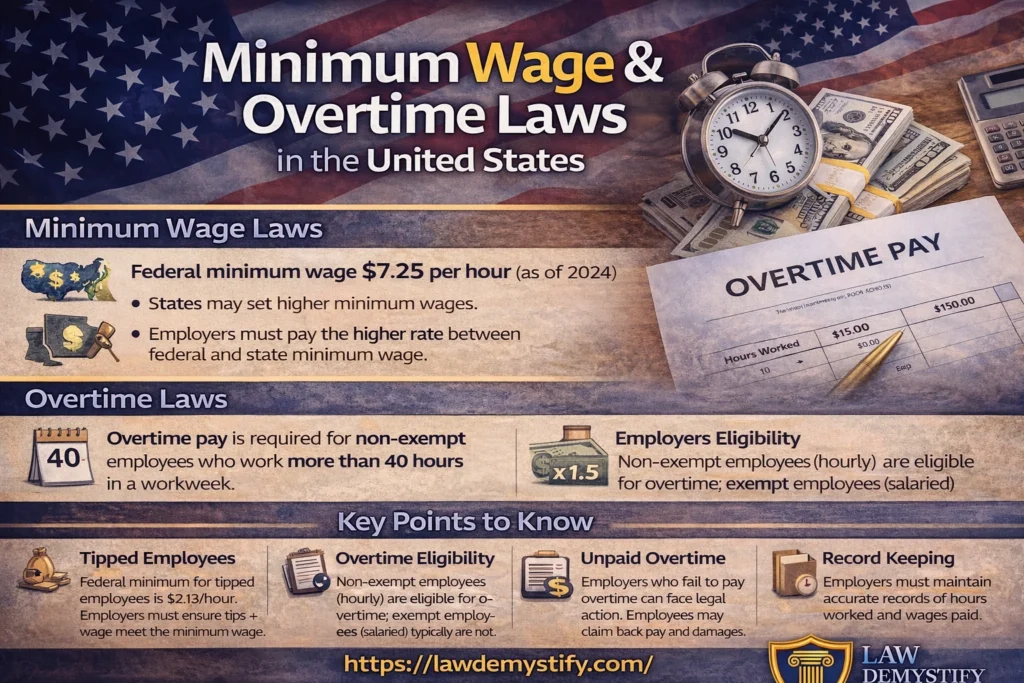
Federal law functions as a floor, not a ceiling. Employers must comply with it everywhere, but they must also follow any state or local law that offers greater protection to workers. Oversight and enforcement are handled by the U.S. Department of Labor, which investigates wage complaints and ensures compliance.
For employees, this federal baseline matters because it guarantees a minimum standard nationwide. For employers, it provides uniform rules that apply across state lines—while still requiring attention to local wage laws.
What Does Minimum Wage Explained Really Mean?
When people hear “minimum wage,” they often think only of an hourly number. In reality, many violations occur quietly—through unpaid minutes, improper deductions, or misclassified job roles. This is far more common than most employees expect. Most workers never receive a clear explanation about how minimum wage actually works in practice. At its core, minimum wage is the lowest hourly rate an employer may legally pay a covered, non-exempt employee for regular working time.
Key points include:
- The wage applies to most hourly workers and some salaried employees.
- Tips, commissions, and bonuses are treated differently depending on job type.
- Certain limited exceptions exist for youth workers, trainees, and tipped employees.
Importantly, minimum wage usa rules focus on actual earnings per hour worked. If an employee’s total pay divided by hours worked falls below the required rate, a violation may exist—even if the employer labels the worker as salaried or pays in other forms.
Federal vs. State Rules: Why Location Matters
One of the most common questions about pay law involves federal vs state minimum wage rules. The answer is straightforward: when federal and state laws differ, the rule most favorable to the employee usually applies.
Many states have enacted higher wages in response to rising living costs. Others adjust their rates annually based on inflation. This has created a wide range of pay standards across the country, making minimum wage by state an essential concept for multi-state employers and remote workers.
For example, an employee working in a state with a $15 hourly minimum must be paid that rate—even though the federal minimum wage remains $7.25. Employers cannot rely on federal law alone when state law provides greater protection.
How Minimum Wage Laws USA Apply in Real Life
In daily practice, minimum wage laws usa shape how businesses structure pay and schedules. Consider a retail worker paid hourly at a state minimum higher than the federal rate. Every regular hour worked must be paid at or above that state rate, regardless of company size or profit margins.
Problems often arise when:
- Employees work “off the clock”
- Required training time is unpaid
- Meal or rest breaks are improperly deducted
- Salaried labels are used incorrectly
In many workplaces, these issues are not obvious at first and are often dismissed as normal or unavoidable. In each of these situations, the issue is not just fairness—it is compliance. Wage laws focus on reality over titles, and enforcement agencies look closely at how pay works in practice.
Overtime Overview: Overtime Laws USA
Beyond minimum pay, overtime is the second pillar of wage protection. Under overtime laws usa, most non-exempt employees must receive extra compensation when they work more than 40 hours in a workweek.
This extra compensation is commonly known as “time and a half.” Under the time and a half law, overtime pay is generally calculated at 1.5 times an employee’s regular hourly rate. For example, an employee earning $20 per hour would typically earn $30 per hour for overtime hours.
Overtime rules apply regardless of whether an employee is paid hourly or salaried. For many employees, learning this comes as a surprise—especially those who have always been told that a salary means no overtime. What matters most is whether the employee is legally classified as exempt or non-exempt—a distinction that often causes confusion and disputes.
How Overtime Pay Explained Works Step by Step
To understand overtime pay explained, it helps to break the process down. First, determine the employee’s regular rate of pay. This may include hourly wages plus certain bonuses or commissions. Next, identify the total hours worked in a single workweek. Any hours over 40 may trigger overtime obligations.
Common misunderstandings include:
- Believing overtime is calculated daily instead of weekly
- Assuming salaried employees are never eligible
- Thinking employers can offer “comp time” instead of overtime pay in the private sector
Federal law focuses on the workweek as the measuring unit. Even if an employee works long days, overtime is only required once the weekly threshold is crossed—unless state law provides stricter rules.
Who Is Covered? Employee Overtime Rights and Eligibility
Not every worker is entitled to overtime, which leads to frequent questions about employee overtime rights. Coverage depends on job duties, pay structure, and salary level—not job titles alone.
Generally, non-exempt employees are eligible for overtime, while exempt employees are not. The most common exemptions apply to executive, administrative, and professional roles that meet specific tests related to duties and salary thresholds.
Misclassification is a major compliance issue. When employees are incorrectly treated as exempt, they may lose substantial overtime pay. Understanding who is eligible for overtime pay is one of the most important steps in protecting wage rights.
Exempt vs. Non-Exempt: Why Classification Matters
The distinction between exempt vs non exempt employees lies at the heart of overtime law. Non-exempt employees are entitled to minimum wage and overtime protections. Exempt employees are excluded from overtime requirements if they meet strict legal criteria.
These criteria focus on:
- The nature of the employee’s primary job duties
- The level of independent judgment exercised
- Whether the employee is paid on a salary basis at or above the required threshold
Labels alone do not control. Calling someone a “manager” or paying a salary does not automatically remove overtime rights. Courts and regulators examine what the employee actually does day to day.
Salary and Overtime: Salary Overtime Rules USA
A common myth is that salaried employees never receive overtime. In reality, salary overtime rules usa recognize that many salaried workers are still non-exempt. If a salaried employee does not meet the exemption tests, overtime may still be required.
For example, an employee paid a fixed weekly salary but performing routine, non-managerial tasks may still qualify for overtime pay. In that case, the salary is converted into an hourly equivalent to calculate overtime rates.
This area of law is especially important for employers, as salary-based misclassification can lead to significant back-pay liability.
State Variations: Overtime Laws by State
Just as minimum wage varies by location, overtime laws by state may offer greater protection than federal law. Some states require overtime after a certain number of hours worked in a day. Others have different rules for specific industries, such as healthcare or agriculture.
When state and federal overtime rules conflict, employers must usually follow the rule that benefits employees most. This makes location-specific knowledge critical, particularly for businesses operating across multiple states.
Real-World Pay Situations Under Minimum Wage USA
Understanding the law is one thing; seeing how minimum wage usa rules apply in everyday workplaces is another. Real-world wage disputes usually arise not from intentional misconduct, but from misunderstandings about how pay laws actually work in daily operations.
Consider a restaurant employee paid hourly plus tips. Even when tips are counted, total earnings must still meet or exceed the applicable minimum wage for every hour worked. If tips fall short, the employer must make up the difference. Similarly, a retail employee required to arrive early to open the store or stay late to close must be paid for that time. When those unpaid minutes add up, the employee’s average hourly pay may drop below the lawful minimum.
These examples highlight a critical principle: wage laws look at reality, not assumptions. If the numbers do not add up, a violation may exist—regardless of intent.
When Employers Get It Wrong: Common Minimum Wage Laws USA Violations
Despite clear rules, minimum wage laws usa are violated more often than many workers realize. The most frequent problems involve unpaid work time, misapplied deductions, and incorrect classifications.
Common violations include:
- Requiring employees to work “off the clock”
- Failing to pay for mandatory training or meetings
- Improperly deducting uniforms, tools, or shortages
- Paying a flat daily or weekly rate that falls below legal minimums
These practices can quietly erode earnings. Over time, small underpayments can become substantial losses, especially for low-wage workers who rely on every dollar earned.
Minimum Wage Explained Through Compliance Examples
To keep minimum wage explained practical, it helps to look at compliance examples. If an employee works 40 hours in a week, their total pay divided by those hours must meet or exceed the applicable minimum wage. Bonuses and commissions may count toward this calculation, but reimbursements and certain benefits do not.
For salaried workers, the same principle applies. A weekly salary that sounds reasonable may still violate wage law if the employee works long hours and the effective hourly rate drops below the legal threshold. This is why wage compliance requires tracking hours—even for some salaried employees.
Overtime in Practice: Applying Overtime Laws USA
Overtime disputes are among the most common wage complaints nationwide. Under overtime laws usa, employers must pay eligible employees premium pay once the weekly hour limit is exceeded. The challenge often lies in correctly calculating the “regular rate” used for overtime.
The regular rate is not always the base hourly wage. It may include:
- Non-discretionary bonuses
- Shift differentials
- Certain commissions
When these amounts are excluded improperly, overtime pay may be undercalculated. This leads to employees receiving less than the full “time and a half” required by law.
Breaking Down Overtime Pay law Misunderstandings
Misunderstandings about overtime pay law frequently cause compliance problems. One common myth is that offering paid time off can replace overtime pay. Many employees accept this without question, only to later learn that private-sector employers generally cannot substitute compensatory time for overtime wages.
Another misconception is that overtime requires employer approval. In reality, if an employer “suffers or permits” an employee to work extra hours, those hours are typically compensable—even if the work was not authorized in advance.
Overtime law prioritizes pay accuracy over internal company policies.
Overtime Pay Explained for Salaried Employees
Salaried workers often ask whether they can receive overtime. Overtime pay explained for salaried employees depends on exemption status, not the method of payment. A salary alone does not eliminate overtime rights. Many salaried employees work long hours, assume overtime does not apply, and only discover years later that they were legally entitled to additional pay.
If a salaried employee is non-exempt, their weekly salary is converted into an hourly equivalent by dividing it by the number of hours the salary is intended to cover. Overtime is then calculated based on that rate for hours worked beyond 40.
This is where salary overtime rules usa become especially important. Misclassifying salaried workers is one of the costliest wage-and-hour mistakes employers make.
Employee Overtime Rights and Workplace Reality
From the employee perspective, employee overtime rights are about fairness and transparency. Workers have the right to be paid for all hours worked and to receive overtime pay when legally required. These rights exist regardless of whether an employee complains or not.
In practice, employees may hesitate to raise concerns out of fear of retaliation or job loss. Wage laws, however, prohibit retaliation for asserting pay rights. Understanding these protections helps employees feel more confident addressing pay discrepancies.
Who Qualifies? who is eligible for overtime pay
The question of who is eligible for overtime pay often turns on job duties. Employees whose primary work involves routine tasks, limited discretion, or manual labor are usually non-exempt and eligible for overtime.
By contrast, exemptions typically apply to roles involving:
- High-level management authority
- Advanced professional knowledge
- Independent decision-making tied to business operations
Even then, salary thresholds and specific duty tests must be met. Eligibility is determined case by case, not by job title alone.
Exempt vs Non-Exempt Employees: Why Errors Matter
The difference between exempt vs non exempt employees has serious financial consequences. When an employee is incorrectly classified as exempt, unpaid overtime can accumulate over months or years. If corrected, employers may face back wages, penalties, and legal fees.
From a compliance standpoint, reviewing job duties regularly is essential. Roles evolve over time, and a position that once met exemption criteria may no longer qualify. Staying current helps prevent costly mistakes.
State Law Impact: Minimum Wage by State and Overtime Variations
State law continues to shape wage standards nationwide. Minimum wage by state can differ significantly, with some states and cities setting rates well above federal levels. Employees working in those jurisdictions must receive the higher wage.
Similarly, overtime laws by state may impose stricter requirements than federal law. Daily overtime rules, industry-specific standards, and higher penalties are common at the state level.
Employers must track where work is performed—not just where the company is headquartered—to ensure compliance.
Frequently Asked Questions About Pay Laws
What is the minimum wage usa today?
The federal rate remains $7.25 per hour, but many states and localities require higher pay. Employees are generally entitled to the highest applicable rate.
How much is overtime pay under overtime rules usa?
Overtime is typically paid at 1.5 times the employee’s regular rate for hours worked over 40 in a workweek, unless state law requires more.
Can salaried employees get overtime?
Yes. Many salaried employees are non-exempt and entitled to overtime under salary overtime rules usa if they do not meet exemption criteria.
Is overtime mandatory?
If an employee works overtime hours and is non-exempt, payment is mandatory. Employers may discipline policy violations but still must pay earned overtime.
Who is exempt from overtime?
Employees in certain executive, administrative, and professional roles may be exempt if they meet strict duty and salary requirements.
Do state laws override federal wage rules?
When state law provides greater protection, it generally takes precedence over federal standards.
What should employees do if wages seem incorrect?
Employees should review pay records carefully and seek reliable information about applicable wage laws before taking action.
Commercial Awareness: Why Wage Knowledge Matters for Businesses
For employers, understanding minimum wage law united states requirements is not just about avoiding penalties—it is about building trust. Transparent pay practices reduce turnover, improve morale, and protect brand reputation.
Businesses that invest in compliance training and regular wage audits are better positioned to grow sustainably. In competitive labor markets, fair pay is both a legal obligation and a strategic advantage.
Clarity and Confidence in Pay Rights
Wage laws in the United States are detailed, but their purpose is simple: ensure workers are paid fairly for their time. From minimum wage usa standards to overtime eligibility, these rules create a baseline of economic security.
For employees, knowledge brings confidence. For employers, compliance brings stability. Most people do not plan to learn wage and hour law. It becomes important only when something feels wrong at work and the answers are not clear. By understanding how minimum wage and overtime laws work together—federally and at the state level—both sides can navigate the workplace with fewer disputes and clearer expectations.
Staying informed is the first step toward protecting pay rights and maintaining lawful, respectful workplaces across the country. For many people, understanding pay laws happens later than it should—often after real financial stress has already begun.