Why Freedom of Speech Still Matters Today
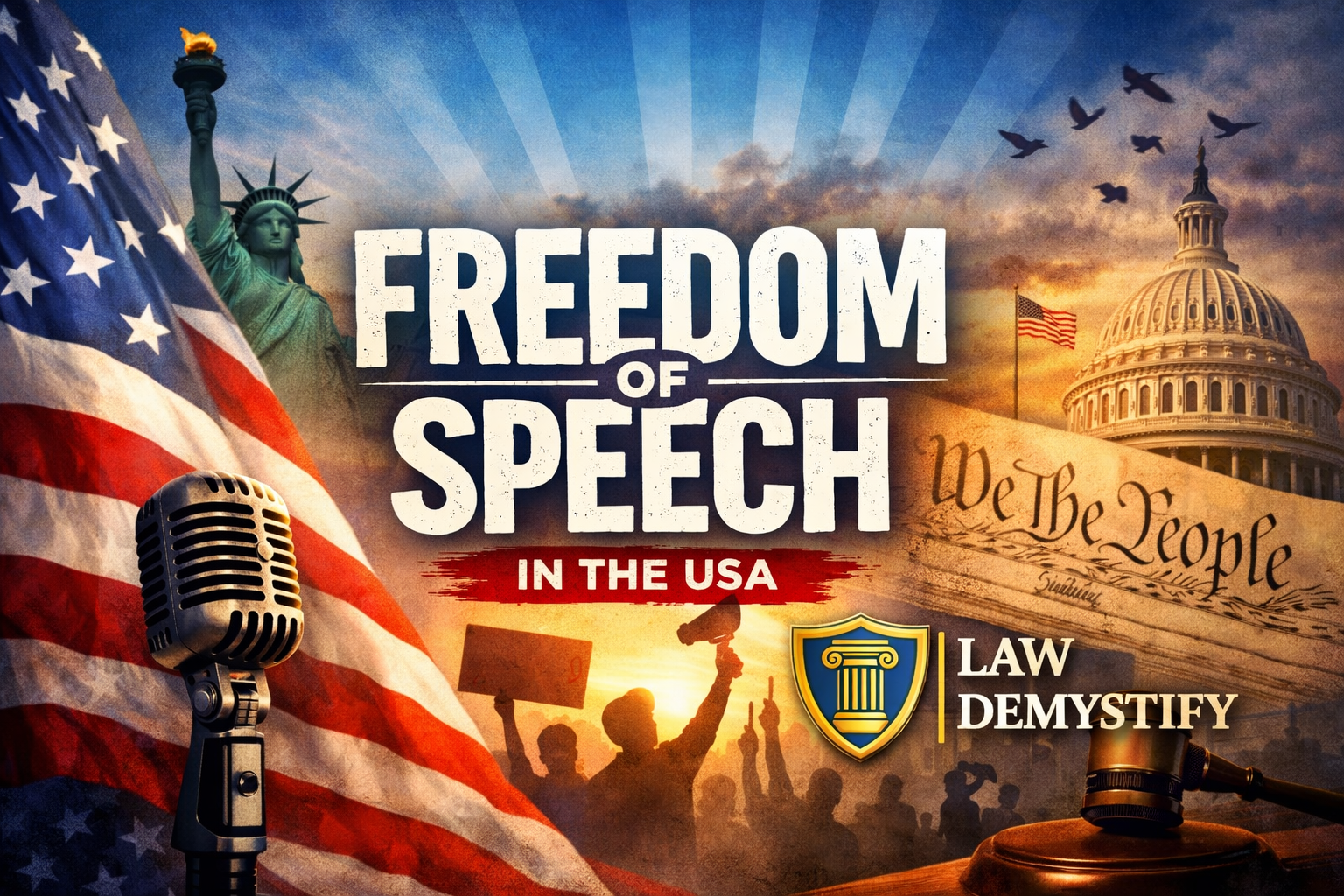
In everyday life—whether posting on social media, speaking at work, protesting in public, or criticizing the government—freedom of speech usa plays a central role in how Americans express ideas and challenge power. Yet many people misunderstand what this right actually protects, when it applies, and when it does not. Some assume they can say anything without consequences. Others believe free speech is disappearing altogether.
The truth lies somewhere in between. Freedom of speech in the United States is a powerful constitutional right, but it is not unlimited. It comes from the First Amendment, is shaped by decades of court decisions, and operates differently depending on where you speak, who you speak to, and who is restricting your speech.
This guide offers constitutional rights explained in clear, practical terms. It is educational legal content USA, written to help beginners and professionals alike understand how free speech works in the real world—what is protected, what is restricted, and why the distinction matters.
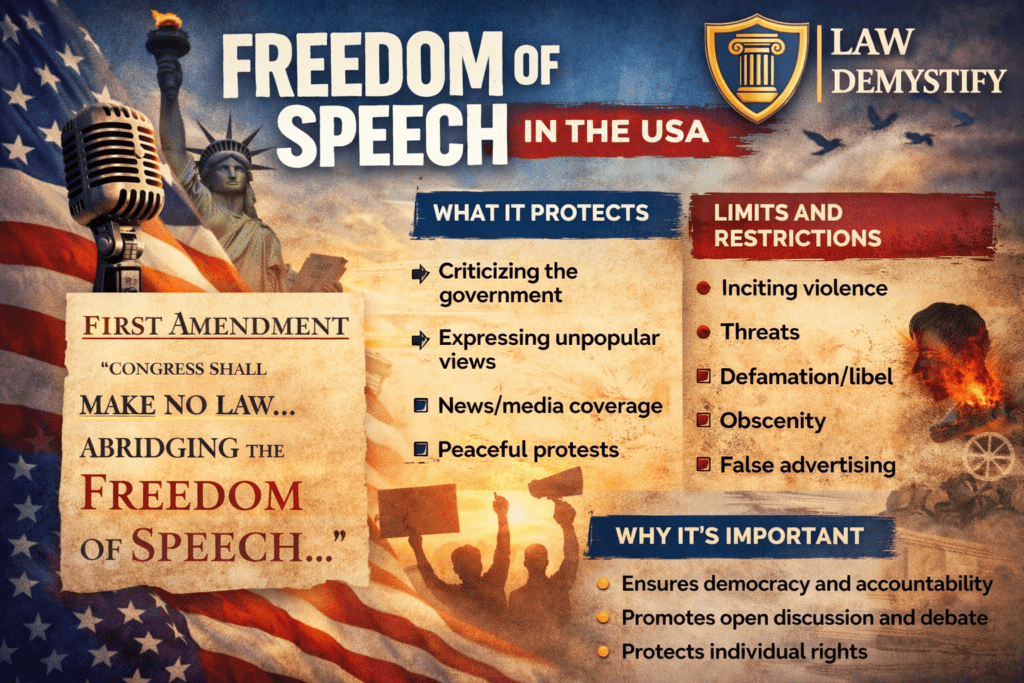
In real life, freedom of speech often becomes relevant in unexpected moments—during a workplace disagreement, a tense traffic stop, a heated school meeting, or a viral social media post that suddenly draws attention. These situations are rarely theoretical. They are personal, emotional, and often confusing. That is why understanding how free speech actually works matters before—not after—a problem arises.
What Is Freedom of Speech in the United States?
At its core, what is freedom of speech means the right to express ideas, opinions, beliefs, and information without unreasonable interference from the government. This protection exists to ensure open debate, political accountability, and personal liberty. It allows people to criticize leaders, discuss controversial topics, and advocate for change without fear of punishment simply for speaking.
However, freedom of speech explained properly requires understanding one key reality that surprises many people once they face a real conflict. The Constitution primarily restricts government action, not private behavior. The First Amendment does not guarantee a right to speak everywhere, at all times, or without consequences. Instead, it protects against government censorship and punishment based solely on expression.
In practice, free speech covers far more than spoken words. Courts have long recognized written expression, artistic works, protests, symbolic acts, and digital communication as forms of speech. This broad understanding is what makes freedom of speech usa such a foundational right—but also one that requires careful limits to balance public order and safety.
The First Amendment and Freedom of Speech
The legal foundation of free expression is the First Amendment to the U.S. Constitution. It states that Congress shall make no law abridging the freedom of speech or of the press. Over time, courts have applied this protection to state and local governments as well.
When people refer to first amendment freedom of speech, they are referring to this constitutional safeguard against government overreach. The amendment ensures that ideas—even unpopular or offensive ones—are not suppressed simply because authorities disagree with them.
Understanding first amendment explained properly means recognizing its purpose: protecting democratic debate, preventing tyranny, and allowing truth to emerge through open discussion. This is why courts often give speech broad protection, especially when it involves public issues, political criticism, or social movements. Still, as discussed later, the First Amendment has carefully defined boundaries.
First Amendment Rights and Their Scope
First amendment rights extend beyond speech alone. They include freedom of religion, the press, peaceful assembly, and petitioning the government. Together, these rights create a framework for civic participation and accountability.
Within this framework, speech receives the strongest protection when it contributes to public discourse. Political debate, advocacy, and commentary on government actions fall at the heart of freedom of speech first amendment protections. Courts consistently hold that suppressing political speech poses the greatest danger to democracy.
At the same time, first amendment protections are not absolute. The Supreme Court has repeatedly recognized that certain forms of expression may be regulated when they conflict with compelling interests such as public safety, national security, or the rights of others. These limits are not loopholes but deliberate guardrails designed to balance liberty with order.
First Amendment Limits: Why Free Speech Is Not Absolute
A common question is whether free speech has any boundaries. The answer is yes. First amendment limits exist to prevent serious harm, violence, or unlawful conduct. These limits are narrow, carefully defined, and often misunderstood.
The government generally cannot restrict speech based on viewpoint. However, it may regulate speech based on time, place, and manner—such as requiring permits for large demonstrations or restricting noise levels at night. These rules must be neutral, reasonable, and applied equally.
In real-world situations, these limits often come into focus only after consequences appear—such as fines, arrest warnings, school discipline, or workplace investigations. Many people assume their speech is protected until they are told otherwise, which is why understanding these limits early can prevent unnecessary legal trouble.
Courts also recognize categories of expression that receive less or no constitutional protection. Understanding these limits is essential to grasping the real-world operation of freedom of speech in the United States and avoiding costly legal misunderstandings.
What Speech Is Protected in the USA?
So, what speech is protected in usa? In general, the Constitution protects most forms of expression, even when they are controversial, offensive, or unpopular. The guiding principle is that speech should not be punished simply because it challenges social norms or authority.
Protected speech commonly includes:
- Political opinions and advocacy
- Peaceful protests and demonstrations
- Artistic and creative expression
- Religious and philosophical views
This protection exists even when speech angers others or causes discomfort. Courts have consistently ruled that emotional offense alone is not a valid reason for government censorship. This strong presumption in favor of protection is what keeps public debate open and diverse.
What Speech Is Not Protected Under the First Amendment?
Equally important is understanding what speech is not protected. Certain categories of expression fall outside First Amendment protection because of their direct potential to cause harm.
Examples of unprotected speech examples include true threats of violence, incitement to imminent lawless action, obscenity as legally defined, and certain forms of harassment. These categories are narrowly defined, and the government bears a heavy burden when regulating them.
The limits of freedom of speech usa are not designed to silence disagreement but to prevent serious, immediate harm. Recognizing this distinction helps explain why some speech may lawfully result in consequences without violating constitutional principles.
Political Speech and the Highest Level of Protection
Among all forms of expression, political speech protection receives the strongest constitutional safeguard. This includes speech about elections, public policy, government officials, and social issues.
The reason is simple: democracy depends on the free exchange of political ideas. Courts are especially skeptical of laws that restrict political expression because such laws can be used to entrench power and silence opposition.
Even harsh criticism of leaders or institutions is generally protected. This robust protection ensures that citizens can hold government accountable—a core purpose of freedom of speech first amendment jurisprudence.
Hate Speech Laws in the USA: A Common Misunderstanding
One of the most misunderstood areas involves hate speech laws usa. Many people assume hate speech is illegal. In reality, hate speech—defined as offensive or hateful expression targeting a group—is often protected under the First Amendment.
Unless hate speech crosses into unprotected categories such as threats, harassment, or incitement to violence, it generally remains lawful. This reflects the principle that the government cannot ban speech simply because it is offensive or disturbing.
Understanding this area is critical to understanding first amendment rights and recognizing the difference between social consequences and constitutional violations.
This distinction often creates confusion because social consequences and legal consequences are not the same. Speech that leads to public backlash, job loss, or platform bans may still be constitutionally protected from government punishment. Understanding this difference helps people separate constitutional law from social reactions.
Commercial and Symbolic Speech
Not all speech receives the same level of protection. Commercial speech explained refers to advertising and marketing. While protected, it can be regulated more heavily to prevent deception or protect consumers.
Similarly, symbolic speech first amendment covers actions meant to convey a message, such as wearing armbands, burning flags, or kneeling during an anthem. Courts often protect symbolic acts when they clearly express ideas, reinforcing the broad scope of free expression.
These categories show how the First Amendment adapts to real-world communication while maintaining consistent principles.
Freedom of Speech and Government Power
A key principle of freedom of speech and government is that constitutional protection exists primarily to limit government action—not to control private behavior. The First Amendment prevents federal, state, and local authorities from punishing individuals simply for expressing ideas or opinions they dislike. This restriction applies to lawmakers, police departments, public schools, and other government bodies.
However, the question can government limit free speech still arises because the answer is not a simple no. Government entities may regulate speech in limited ways to serve legitimate interests, such as maintaining public order or protecting national security. These restrictions must be narrowly tailored and applied neutrally, without targeting specific viewpoints.
Understanding this balance helps explain why free speech remains strong in the United States while still operating within defined legal boundaries.
Freedom of Speech vs Public Safety
One of the most sensitive areas of constitutional law involves freedom of speech vs public safety. Courts recognize that while expression is vital, it cannot be used as a shield for conduct that creates an immediate risk of harm.
Speech that directly incites violence, triggers panic, or interferes with emergency response may be restricted. For example, urging a crowd to engage in immediate unlawful acts can lose First Amendment protection. These rules are designed to prevent real-world danger, not to suppress unpopular opinions.
The limits of freedom of speech usa in this context focus on imminence and severity. General advocacy is protected; direct calls for immediate harm are not. This distinction is essential for understanding how public safety concerns intersect with constitutional rights.
Freedom of Speech and National Security
Another area where restrictions arise is freedom of speech and national security. The government has a compelling interest in protecting classified information, military operations, and national defense.
While criticism of government policy is protected, disclosing sensitive information that endangers lives or national security may be restricted. Courts weigh these cases carefully, recognizing both the importance of transparency and the need for protection.
These cases illustrate how first amendment limits operate in practice—rare, specific, and subject to strict judicial scrutiny rather than broad censorship.
Freedom of Speech in Public Places
Many people assume free speech applies equally everywhere, but freedom of speech in public places depends on the type of location. Traditional public forums—such as sidewalks, parks, and public squares—receive the highest level of protection.
In these spaces, the government may impose reasonable time, place, and manner restrictions, such as permit requirements for large demonstrations. These rules must be content-neutral and applied fairly.
Nonpublic forums, such as government offices or courthouses, allow for greater regulation. Understanding where speech occurs is just as important as what is being said when evaluating constitutional protection.
Freedom of Speech and Police Interactions
Questions about freedom of speech and police arise frequently during protests, traffic stops, or public encounters. In general, individuals have the right to verbally criticize or question police officers, as long as the speech does not interfere with lawful duties.
Courts have repeatedly held that verbal criticism alone is not a crime. However, speech combined with obstruction, threats, or physical interference may lose protection. This distinction matters during real-world interactions.
Knowing these boundaries helps individuals exercise their rights confidently while avoiding unnecessary escalation or legal trouble. For example, courts have ruled that calmly recording police activity or verbally questioning an officer—without threats or physical interference—does not automatically justify arrest. Problems often arise not from speech itself, but from how tense situations escalate when rights and boundaries are misunderstood.
Freedom of Speech at the Workplace
A common misconception involves freedom of speech at workplace settings. The First Amendment does not usually apply to private employers. Private companies may set rules about employee speech, conduct, and communication as part of workplace policies.
Public employees, however, have limited First Amendment protection when speaking as private citizens on matters of public concern. Even then, speech that disrupts operations or undermines job performance may be regulated.
This area often leads to confusion because constitutional rights and employment rules operate differently. Understanding this distinction is essential for realistic expectations. This is why many people are surprised to learn that workplace discipline often involves company policy rather than constitutional law.
Freedom of Speech at School
Freedom of speech at school operates under unique rules. Students do not lose all constitutional rights, but schools may regulate speech to maintain order and support educational goals.
Courts allow restrictions on speech that is disruptive, lewd, or inconsistent with the school’s mission. At the same time, students retain rights to express opinions, particularly on political or social issues, within reasonable limits.
These rules aim to balance student expression with the responsibility to provide a safe and effective learning environment.
Freedom of Speech on Social Media
In the digital age, freedom of speech on social media is one of the most misunderstood topics. Social media platforms are private companies, not government actors. As a result, they are generally not bound by the First Amendment.
This means platforms may remove content or suspend accounts based on their own policies. The question does freedom of speech apply to private companies is usually answered no, under current law.
However, government officials using social media for official purposes may face constitutional limits when blocking users based on viewpoint. This evolving area of law continues to shape online expression.
What Speech Is Protected vs Restricted: A Practical Overview
To summarize the distinction between protected and unprotected speech, consider the following general framework:
- Protected speech includes political advocacy, peaceful protests, opinions, and most expressive conduct
- Restricted or unprotected speech may include true threats, incitement to immediate violence, and certain forms of harassment
This practical understanding helps clarify what speech is protected in usa versus what speech is not protected without oversimplifying the law.
Many people don’t start learning about the law until a problem suddenly appears—such as receiving a legal notice, facing a dispute at work, or having an unexpected interaction with authorities. In those moments, confusion and stress often take over.
Having a basic understanding of the law before something goes wrong can make these situations far less overwhelming. If you want a clear foundation of how laws work, what rights exist, and how the U.S. legal system is structured, our Legal Basics in the United States: A Beginner’s Guide explains these core concepts in simple, practical terms designed for everyday life—not legal jargon.
Frequently Asked Questions About Freedom of Speech
Does freedom of speech have limits?
Yes. Courts recognize narrow limits where speech poses a real and immediate risk of harm or violates specific legal standards.
Can you say anything under free speech?
No. While protection is broad, certain categories such as threats or incitement are not protected.
Is hate speech protected by the First Amendment?
In many cases, yes. Hate speech is generally protected unless it crosses into unprotected categories like threats or violence.
Can freedom of speech be taken away?
The government cannot remove free speech rights entirely, but it may impose limited restrictions under specific circumstances.
Does freedom of speech apply to private companies?
Generally no. Private employers and platforms are not bound by the First Amendment.
Are protests always protected speech?
Peaceful protests are usually protected, but permits and reasonable regulations may apply.
Do public employees have free speech rights?
They do, but those rights are limited and depend on the context and subject of the speech.
Conclusion: Understanding Your Rights Without Misconceptions
Freedom of speech usa remains one of the strongest and most influential constitutional rights in American law. Rooted in the First Amendment, it protects open debate, political dissent, and personal expression. At the same time, it operates within carefully defined limits designed to protect public safety, order, and national interests.
This guide provides legal information only and serves as a legal guide for beginners seeking clarity rather than confusion. By understanding first amendment rights, individuals can better exercise free speech responsibly while recognizing when legal boundaries apply.
In real life, free speech questions rarely arise in calm, planned moments—they surface during conflict, pressure, and uncertainty. Knowing both your rights and their limits before that moment arrives can make the difference between confidence and costly mistakes.