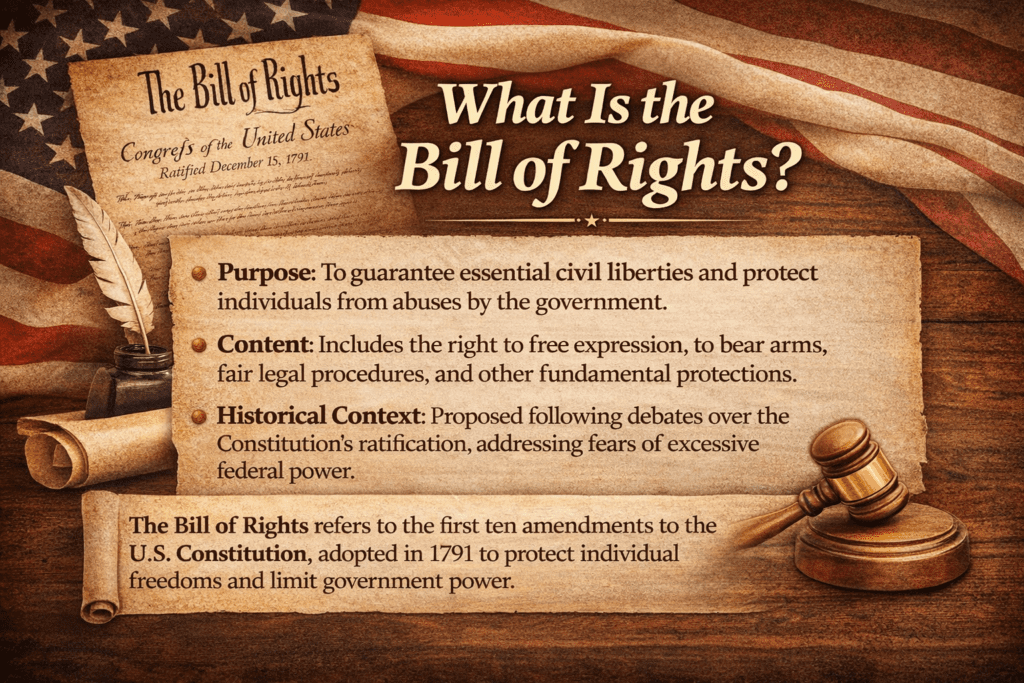
The Bill of Rights is the first ten amendments to the U.S. Constitution, adopted in 1791 to protect individual freedoms and limit government power. Many people hear the term in school, news, or court discussions, but few understand how it applies in everyday life.
Many people hear the term what is the Bill of Rights in school, news, or court discussions, but few truly understand what it means in everyday life. The Bill of Rights is not just a historical document—it is a living foundation of freedom that continues to shape how laws are enforced and how government power is limited in the United States.
At its core, a simple explanation of the Bill of Rights begins with one idea: it exists to protect everyday people from unfair or excessive government power. These rights affect daily interactions with law enforcement, courts, schools, and public institutions. From free speech to fair trials, the Bill of Rights defines essential protections that apply to real people in real situations. For many people, these rights feel theoretical until a real situation arises—such as a police interaction, a school rule dispute, or a court notice—where knowing your rights suddenly matters.
This guide explains the Bill of Rights clearly and practically, making it ideal as a bill of rights for beginners. Whether you are a student, professional, or simply curious, this article provides general constitutional law information for educational purposes only. For many people, the Bill of Rights only becomes relevant when their freedom, privacy, or fairness is questioned in real life.
As legal education content creators, we see this confusion every day—people often learn about their rights only after a situation has already become stressful. In practice, many people only look up these rights after receiving a notice, being questioned by authorities, or facing a situation they never expected.
Before diving into the details, it helps to step back and consider what the Bill of Rights actually means in day-to-day life.
What Is the Bill of Rights in the United States?
To understand what the Bill of Rights is, it helps to look at its role within American law. The Bill of Rights refers to the first ten amendments added to the U.S. Constitution. This clarity helps prevent misunderstandings between citizens and government authorities in everyday legal situations.
The bill of rights in the United States was adopted in 1791 to address concerns that the Constitution gave too much power to the federal government. Many feared that without explicit protections, citizens’ freedoms could be ignored or violated.
In simple terms, the Bill of Rights sets limits on government authority. It ensures that people have fundamental freedoms that cannot be taken away lightly. This is why the bill of rights explained remains one of the most important elements of American democracy.
Why Was the Bill of Rights Created?
A common beginner question is why was the Bill of Rights created. After the Constitution was drafted, many Americans worried that it did not adequately protect personal freedoms. People wanted written protections they could rely on, especially when facing powerful government institutions. This concern wasn’t abstract—it reflected real fears people had about unchecked authority.
The bill of rights constitution relationship is essential. The Constitution establishes government powers, while the Bill of Rights restricts those powers. Together, they create balance.
The purpose of the Bill of Rights was to:
- Protect individual liberty
- Prevent abuse of government power
- Guarantee fairness in legal proceedings
These goals explain why the rights protected by the Bill of Rights are still actively enforced today.
Bill of Rights Amendments: The First Ten Amendments Explained
The bill of rights amendments are collectively known as the first ten amendments to the Constitution. Each amendment protects specific freedoms or legal rights.
Understanding the first ten amendments explained helps beginners see how constitutional protections work together. Some amendments focus on personal freedom, while others ensure fairness in the justice system.
Below is a simplified explanation of the most commonly discussed amendments.
First Amendment Explained
The first amendment explained protects core freedoms that define democratic society. It guarantees freedom of speech, religion, press, assembly, and the right to petition the government.
This amendment allows people to express opinions, practice religion freely, and criticize government actions without fear of punishment. The bill of rights freedoms found in the First Amendment are central to public debate and civic participation.
In everyday life, the First Amendment affects protests, social media expression, and religious practices. These protections often become most noticeable when speech is challenged, beliefs are questioned, or public expression is restricted.
Second Amendment Explained
The second amendment explained focuses on the right to keep and bear arms. It has been widely debated and interpreted through court decisions.
While often discussed in political terms, this amendment reflects early concerns about self-defense and security. Courts balance this right with public safety considerations.
Understanding this amendment helps clarify how individual rights under the Bill of Rights are interpreted over time.
Fourth Amendment Explained
The fourth amendment explained protects people from unreasonable searches and seizures. It requires law enforcement to have probable cause and, in most cases, a warrant.
This amendment plays a major role in criminal investigations and privacy rights. The bill of rights and police powers relationship is especially clear here.
In daily life, this protection applies to homes, vehicles, and personal property.
Fifth Amendment Explained
The fifth amendment explained ensures fairness in legal proceedings. It includes protection against self-incrimination, double jeopardy, and guarantees due process of law.
The bill of rights and due process connection is strongest in this amendment. It ensures that the government follows fair procedures before depriving someone of life, liberty, or property.
This amendment is frequently applied in criminal and civil cases.
Sixth Amendment Explained
The sixth amendment explained guarantees the right to a fair and speedy trial. It includes the right to an attorney, an impartial jury, and the ability to confront witnesses.
This amendment protects defendants and ensures transparency in criminal cases. It is essential to the integrity of the justice system.
The Sixth Amendment shows how the civil liberties bill of rights directly protect individuals facing legal action.
Eighth Amendment Explained
The eighth amendment explained prohibits excessive bail, excessive fines, and cruel and unusual punishment. It limits how the government can punish individuals.
This amendment reflects evolving standards of fairness and human dignity. Courts continue to interpret what constitutes excessive or cruel punishment.
It plays a critical role in sentencing and corrections policy.
What Does the Bill of Rights Protect?
Another common question is what does the Bill of Rights protect. Broadly, it protects personal freedom, legal fairness, and privacy.
The rights protected by the Bill of Rights include:
- Freedom of speech and religion
- Protection against unreasonable searches
- Fair trial rights
- Protection from excessive punishment
These protections form the foundation of understanding constitutional rights in the United States.
Bill of Rights and the Constitution: What’s the Difference?
People often ask about the bill of rights and constitution difference. The Constitution establishes the structure of government, while the Bill of Rights limits government power over individuals.
Together, they work as a unified legal framework. The Constitution grants authority; the Bill of Rights protects liberty.
This distinction helps beginners understand why both documents are essential.
Does the Bill of Rights Apply to States?
A frequent question is does the Bill of Rights apply to states. Originally, the Bill of Rights applied only to the federal government.
Over time, courts have applied most of these rights to the states through constitutional interpretation. This ensures nationwide protection of fundamental freedoms.
Can the Bill of Rights Be Limited?
Many wonder can the Bill of Rights be limited. Rights are not absolute. Courts allow reasonable restrictions when necessary for public safety or order. Courts examine these limits carefully to ensure they do not unnecessarily infringe on fundamental freedoms. That balance is not always obvious, and courts often have to decide where reasonable limits end and constitutional protections begin.
However, any limitation must meet strict legal standards. This balance preserves freedom while addressing societal needs.
Who Is Protected by the Bill of Rights?
Another important question is who is protected by the Bill of Rights. In most cases, these protections apply to all people within U.S. jurisdiction, not just citizens.
Courts recognize that fundamental rights are tied to human dignity and fairness.
Bill of Rights in Everyday Life
The bill of rights in everyday life often comes into play during moments people don’t plan for—such as a traffic stop on a routine drive, a school disciplinary hearing, or being questioned by police without clear explanation. Free speech protections apply at public events, due process rights apply in courts, and search protections apply during police encounters.
Examples include:
- Speaking openly without government censorship
- Legal protections during arrests or trials
- Religious freedom in public and private life
These examples show how the Bill of Rights remains relevant today.
FAQ’s The Bill of Rights
What is the Bill of Rights?
It is the first ten amendments to the U.S. Constitution protecting individual freedoms.
What are the first ten amendments explained simply?
They outline freedoms, legal protections, and limits on government power.
Why was the Bill of Rights important?
It protects citizens from government overreach.
Does the Bill of Rights still apply today?
Yes, it remains a core part of U.S. law.
Can rights under the Bill of Rights be restricted?
Yes, but only under strict legal standards.
Does the Bill of Rights protect non-citizens?
Many protections apply to all persons within the U.S.
Is this legal advice?
No. This is legal information only.
To explore related topics, you may also want to read our guide on Constitutional Rights Explained. For a complete beginner-friendly overview of how these rights fit into the broader legal system, see our pillar guide on Legal Basics in the United States.
Conclusion
Understanding the Bill of Rights is not just about memorizing amendments. It empowers you to recognize your freedoms, respond confidently in legal situations, and understand the limits of government power in everyday life.
From free speech to due process, the individual rights under the Bill of Rights remain central to American democracy. When people understand these protections, they are better equipped to recognize their rights and responsibilities.
Because many constitutional protections apply differently at the federal and state level, it helps to understand the difference between Federal Law vs State Law in the USA.