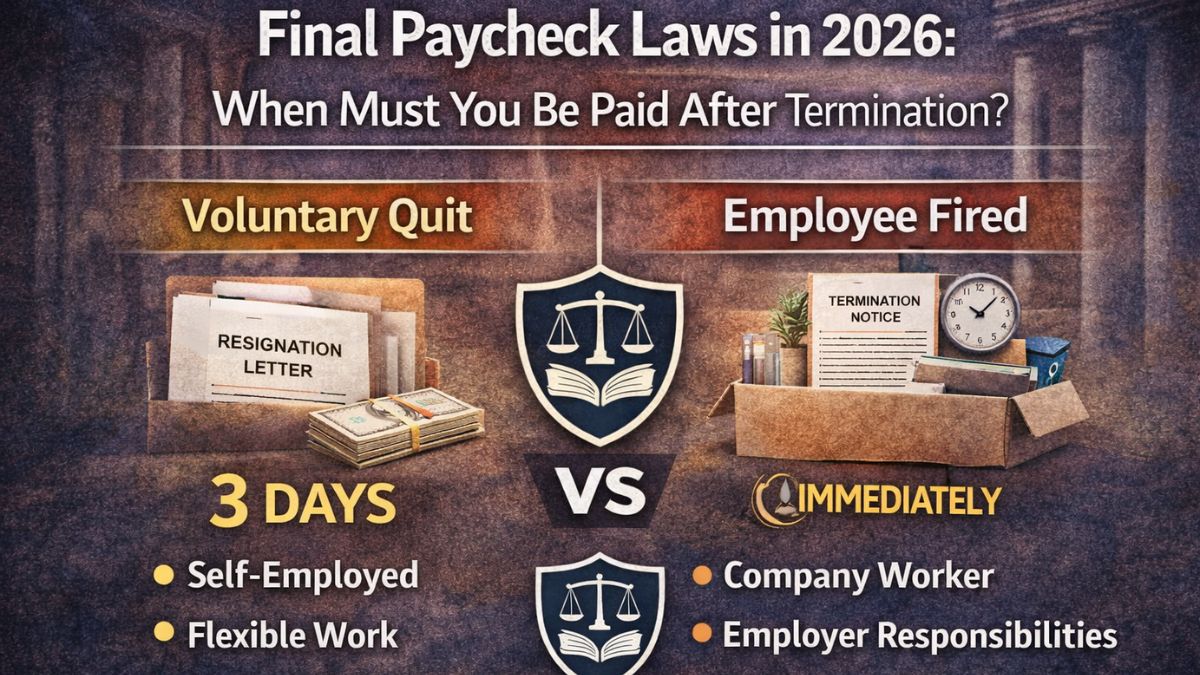

You Got Fired. Now What About Your Money?
You’re called into a meeting. HR informs you that your employment is over — effective immediately. Your security badge is collected, your laptop is returned, and you walk out.
But one question keeps running through your mind:
“When do I get my final paycheck?”
Surprisingly, the answer depends entirely on the state where you worked.
Most employees assume federal law sets one clear rule — but that is not how final paycheck laws work in the United States.
Key Points About Final Paycheck Laws in the U.S.
- There is no single federal rule requiring immediate payment upon termination.
- Timing is largely controlled by state law, and rules vary dramatically:
- Some states require immediate payment upon termination.
- Others allow payment by the next regular payday.
- Rules may differ depending on whether you quit or were fired.
Why It Matters
Understanding final paycheck law is about more than timing. It can affect:
- Unpaid wages
- Accrued but unused vacation or PTO
- Commissions or bonuses
- Potential penalties if payment is delayed
For many workers, this final paycheck is not extra money — it is money already budgeted for essential expenses.
Knowing your state’s rules ensures you receive all compensation owed and can take action if your employer delays payment.
Is There a Federal Final Paycheck Law?
No. There is no federal law that sets a universal deadline for issuing a final paycheck after termination.
- Federal wage law, enforced by the U.S. Department of Labor, ensures employees receive minimum wage and overtime for hours worked. However, it does not dictate the timing of final pay.
- The responsibility for final paycheck timing falls to state law.
- Therefore, the first legal question after termination is: Which state’s law applies?
- Typically, it is the state where you physically performed work.
Why State Laws Matter So Much
State laws differ significantly in how they handle final paychecks:
- Some states require immediate payment if an employee is fired.
- Others allow payment on the next scheduled payday.
- Deadlines can differ depending on whether the employee resigns with notice or is terminated without notice.
Examples
- In certain states, fired employees must be paid immediately at termination.
- In other states, employers may have several days to process final payroll.
- Some states impose daily penalties for late payment.
These differences determine whether you receive your money the same day or wait weeks. For someone living paycheck to paycheck, that difference can feel overwhelming.
Understanding your state’s rules is critical to ensure you receive all wages and any applicable penalties for delayed payment.
Fired vs. Resigned: Why the Reason Matters
State laws often treat termination differently depending on who initiated it:
- Employer-initiated termination (fired): Deadlines for issuing a final paycheck are often shorter, sometimes requiring immediate payment.
- Employee-initiated resignation: Employers may have more time to process the final paycheck, especially if the resignation is without notice.
- Some states reward employees who give advance notice by requiring quicker payment.
Many workers are surprised to learn that the reason for separation directly affects legal timing requirements.
What Must Be Included in the Final Paycheck?
A final paycheck typically goes beyond base salary. It may include:
- All unpaid regular wages
- Overtime earned but not yet paid
- Earned and calculable commissions
- Unused vacation or paid time off (PTO) in some states
Vacation Payout Nuances
- Federal law does not require employers to pay unused vacation.
- Some states consider accrued vacation as earned wages, requiring payout upon separation.
- Other states allow employers to follow written company policy. If the policy states that unused vacation is forfeited upon termination, that may be lawful in those states.
Both state law and the employer’s written policy are critical when determining what must be included in a final paycheck.
Commissions and Bonuses
Commission payments and performance-based bonuses can lead to disputes after termination.
Key Points
- Earned commissions must generally be paid, even if employment ends, provided they were earned under the terms of the compensation agreement.
- If the plan specifies that commissions are only earned upon client payment or after reaching a specific milestone, payment may depend on whether those conditions were met before termination.
- Courts frequently examine the written commission or bonus agreement to determine entitlement.
Legal Focus
The central question is:
Was the commission or bonus legally earned before employment ended?
- If yes, the employer is usually obligated to include it in the final paycheck.
- If no, payment may not be required, depending on the contract and state law.
Proper documentation and understanding the terms of your commission agreement can prevent disputes or strengthen a claim for unpaid earnings.
Real-World Scenario: Delayed Final Pay
An employee is terminated on Monday in a state that requires immediate payment. The employer informs them that payment will be made on the next regular payday, two weeks later.
- Under state law, this delay may violate wage statutes.
- Some states impose waiting-time penalties for each day the final paycheck is late.
- What may seem like a simple administrative delay can quickly become a wage law violation.
- What feels like a small payroll delay to an employer can create immediate financial stress for the employee.
Real-World Scenario: Resignation Without Notice
An employee resigns abruptly on Friday without giving two weeks’ notice.
- State law allows employers up to the next scheduled payday to issue final wages for voluntary resignations.
- The employer processes payroll normally, and payment is issued the following week.
- In this scenario, the employer likely complied with state law.
Key takeaway: Timing matters — and so does who initiated the separation.
Remote Work Complications
Remote work adds another layer of legal complexity:
- If you work remotely in one state for a company headquartered in another, which state’s final paycheck law applies?
- Typically, the law of the state where the employee physically worked governs wage timing.
- Some employment contracts include choice-of-law clauses, but courts often prioritize employee protection under local wage laws.
- Multi-state employers must track remote worker locations carefully to remain compliant and avoid penalties.
What Happens If Final Pay Is Late?
If an employer fails to pay final wages on time, employees have several potential legal remedies:
- Some states impose statutory penalties that increase daily until payment is made.
- Employees can file wage claims with state labor agencies.
- In certain cases, employees may bring lawsuits seeking unpaid wages, penalties, and attorney’s fees.
Because many states strictly enforce wage laws, employers risk significant liability for non-compliance.
Even so, many employees hesitate to take action because they fear conflict or believe the delay is temporary.
Emotional Reality: Why Workers Often Stay Silent
After termination, many workers prioritize finding new employment:
- Some avoid raising concerns about delayed payment.
- Others assume a short delay is harmless.
However, final pay is not optional — it is earned compensation. It is money you have already worked for.
Knowing your rights regarding timing and state laws can help you:
- Ensure you receive all owed wages
- Avoid unnecessary financial stress
- Take action if payment is unreasonably delayed
Awareness and documentation are key to protecting your earned income.
What If Your Employer Delays Your Final Pay?
A delayed final paycheck is more than an inconvenience — in many states, it can be a legal violation.
Key Points About Delayed Pay
- Some states impose strict “waiting time” penalties, meaning employers may owe additional wages for each day payment is late, up to a statutory limit.
- Example: In certain states, penalties may equal one full day of wages for every late day. In others, employees can recover interest, statutory damages, and attorney’s fees.
- Even in states without automatic penalties, employees can still file wage claims to recover unpaid compensation.
- Employers sometimes assume a short delay is harmless, but legally, that assumption can be costly.
How to File a Final Paycheck Claim

If your final paycheck is not received within the required timeframe, you generally have two main options:
- File a complaint with your state labor department:
- Most states have agencies dedicated to enforcing wage laws.
- The agency may investigate payroll records, contact the employer, and order payment.
- File a private lawsuit for unpaid wages
- Many state laws allow recovery of attorney’s fees, making litigation more accessible.
- Federal enforcement through the U.S. Department of Labor may apply if minimum wage or overtime issues are involved, but timing rules for final pay are typically state-based.
Pro tip: Always request payment in writing before filing. Documentation strengthens your claim and establishes the timeline of the delay.
Statute of Limitations: Don’t Wait Too Long
Every state imposes a time limit for filing final paycheck or wage claims.
- Some states allow only one year to file.
- Others provide two to four years, depending on the type of claim.
- The clock usually starts on the date the final paycheck should have been issued.
Waiting too long can permanently eliminate your ability to recover unpaid wages. Even small amounts can add up, especially when late payment penalties apply.
Tip: Acting promptly ensures you can recover all owed final wages, including penalties.
Vacation Pay Disputes: The Most Common Conflict
Unused vacation or paid time off (PTO) is one of the most frequent sources of final paycheck disputes.
- Federal law does not require employers to pay unused vacation.
- Many states, however, treat earned vacation as wages, requiring payout upon termination.
- In some states, employers may enforce written policies stating that unused vacation is forfeited if conditions are not met.
The outcome depends on state law and the specific language in the employer’s policy. Employees who are denied vacation payout should request a copy of the written policy and review it carefully.
Commissions After Termination
Commission-based employees often face disputes after leaving a company. A common question arises: if a sale was completed but payment from the client has not yet been processed, is the commission still owed?
The answer depends on the terms of the compensation agreement:
- Commission earned upon closing the sale: If the agreement specifies that commissions are earned when the sale closes, the employee is typically entitled to the commission even after termination.
- Commission earned upon payment receipt: If the agreement states that commissions are earned only after the client’s payment is received and the employee is actively employed at that time, the employer may argue that the commission is not owed.
Courts often closely analyze written commission plans, and clear documentation is usually decisive in resolving disputes.
Severance vs. Final Pay: Understanding the Difference
Many employees confuse severance with final pay, but they are not the same:
- Final pay: Legally required compensation for work already performed. Employers must pay these wages regardless of any agreements or releases.
- Severance: Optional compensation offered by the employer, often in exchange for signing a release of claims. Employers cannot condition the payment of earned wages on the employee signing a severance agreement.
Understanding this distinction is critical. Final wages must always be paid, whereas severance is discretionary and tied to additional agreements.
Employer Defenses in Final Pay Disputes
Employers sometimes raise defenses when final pay is disputed:
- Administrative delays: Employers may claim delays were unintentional or due to administrative errors.
- Unreturned company property: Some employers argue that wages can be withheld until property is returned. However, in many states, withholding earned wages for unreturned property is unlawful.
- Unpaid bonuses or commissions: Employers may contend that certain bonuses or commissions were not yet earned under the contract.
Courts evaluate these defenses based on statutory requirements and the specific language of written agreements. While intent may influence penalties, it rarely excuses the non-payment of wages already earned.
Remote Workers and Multi-State Employers
With the rise of hybrid and remote work, employers often have employees in multiple states. This creates special payroll considerations:
- Payroll departments must comply with the final paycheck timing rules of the state where each employee physically works.
- Mistakenly applying the headquarters’ state law to all employees can lead to wage violations.
- Remote employees should confirm which state’s law governs their employment, especially if they relocate during their tenure.
Understanding these rules is critical for both employers and employees to avoid wage disputes.
Practical Steps If You Haven’t Been Paid
If your final paycheck is late or incomplete, follow these structured steps:
- Document key details: Record your termination date and the expected payment date.
- Request payment in writing: Send a formal written request to your employer for the owed wages.
- Check state resources: Review your state’s labor department website for instructions on filing a wage complaint.
- Preserve records: Keep copies of pay stubs, time records, and employment agreements.
Maintaining clear documentation strengthens your position if the dispute escalates to legal action.
Taking calm, documented steps early often resolves the issue faster than waiting and hoping it fixes itself.
Frequently Asked Questions
Can my employer withhold my final paycheck if I didn’t return equipment?
In many states, no, they cannot. Employers are generally required to pay all earned wages regardless of disputes over company property.
Does direct deposit timing matter?
Yes. The paycheck must be available to you within the legally required timeframe, not just processed internally by the employer.
What if my final paycheck bounces?
A bounced paycheck may result in additional penalties under state wage laws.
Can I recover attorney’s fees?
Many state wage statutes allow employees to recover attorney’s fees if they successfully pursue a claim.
Is a small delay worth pursuing legally?
Even short delays can trigger statutory penalties depending on the state law, so it may be worth taking action.
Are commissions owed after I leave the company?
It depends on your compensation agreement. If commissions are earned upon closing a sale, you are typically entitled to them even after termination. If they are earned only after payment is received while employed, the employer may not owe them.
Can an employer require me to sign a severance agreement to receive final pay?
No. Final wages for work already performed must be paid regardless of any severance agreement. Severance is optional and separate from legally owed wages.
What should I do if my employer claims I owe them money from unreturned property?
While employers may attempt to withhold wages for unreturned items, many states prohibit this. Always check your state’s labor laws before allowing any deductions.
How do multi-state rules affect my final paycheck?
If you work remotely or in another state, your final pay must comply with the labor laws of the state where you physically worked, not necessarily the state where the company is headquartered.
How long does an employer have to issue my final paycheck?
The timeframe varies by state, but most states require payment immediately or within a few days to a few weeks after termination, depending on whether you were fired or resigned. Check your state’s labor department for the exact deadline.
Final Conclusion
Final paycheck laws are often overlooked but are a financially critical part of employment termination. There is no single national rule — timing and requirements vary based on state law, the reason for separation, and the type of compensation owed.
Earned wages are not optional — they are a legal obligation. They represent work you have already performed and time you cannot get back. Delays can expose employers to penalties, interest, and potential litigation. For employees, understanding your state’s specific timing requirements helps ensure you receive the money you have already earned without unnecessary delay.
When employment ends, clarity about final compensation matters just as much as the separation itself. Knowing your rights and obligations can prevent disputes and protect both employees and employers.