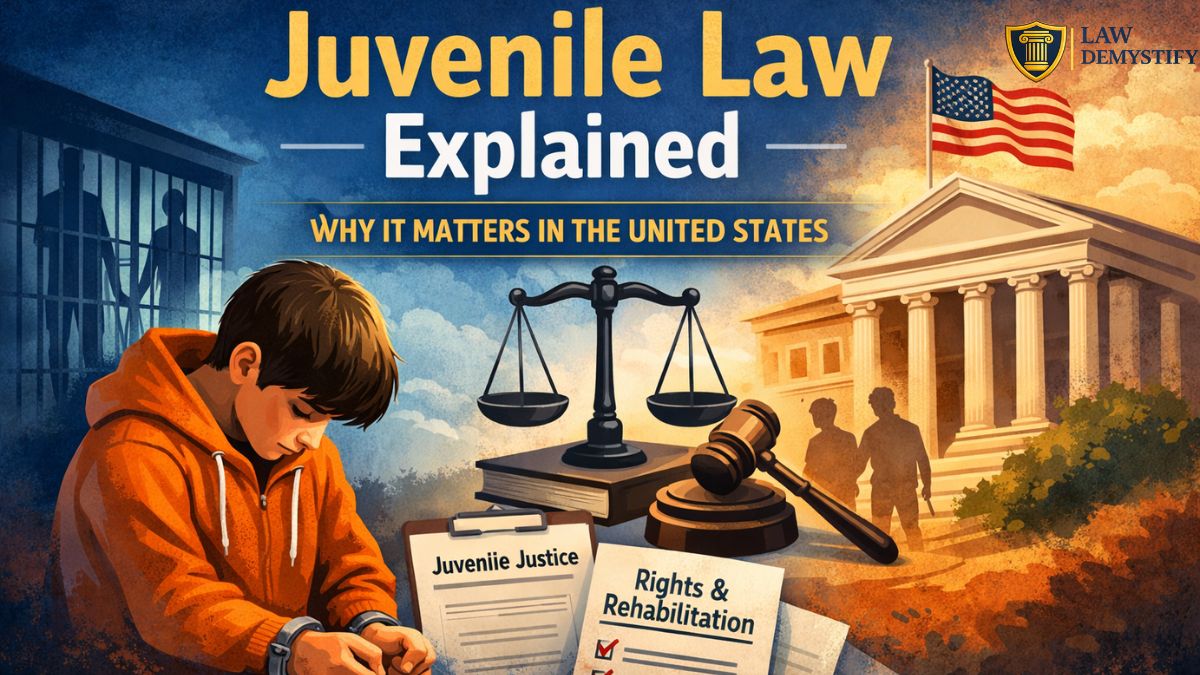
Juvenile law is the area of law that deals with cases involving children and teenagers who are under the age of 18. Instead of treating minors the same as adults, the U.S. legal system uses a separate court process that takes a child’s age and circumstances into account. The goal is to help minors learn from their mistakes, protect their legal rights, and reduce the chances of future offenses whenever possible.
In the United States, most cases involving minors are handled through the juvenile justice system, which operates separately from the adult criminal court system. While state laws vary, juvenile courts generally focus on rehabilitation through education, counseling, probation, and community-based programs rather than long-term punishment. In more serious cases, however, a minor may be transferred to adult court if state law allows it.
Understanding juvenile law can help parents, guardians, educators, and young people know what to expect if a minor becomes involved in the legal system. It also makes it easier to understand how juvenile courts work, what legal rights a child has, and how court decisions can affect education, family life, and future opportunities.
How Does Juvenile Court Work in the United States?
When a minor is accused of breaking the law, the case is usually handled in juvenile court instead of adult criminal court. The purpose of the juvenile court is to determine what happened, protect the child’s legal rights, and decide on an appropriate outcome based on the facts of the case and the minor’s individual circumstances. Although procedures vary by state, juvenile courts generally place a stronger emphasis on rehabilitation than punishment.
A juvenile case usually begins after a police referral, school incident, or complaint filed by law enforcement. Before the case moves forward, an intake officer or probation department reviews the facts to determine whether the matter should be dismissed, resolved through a diversion program, or scheduled for a court hearing. This early review helps ensure that less serious cases are handled appropriately without unnecessary court involvement.
If the case proceeds, the court may hold several hearings to determine whether the allegations are supported by evidence and what outcome best serves both the minor and the community. Depending on state law and the circumstances of the case, the judge may order probation, counseling, community service, educational programs, restitution, or other rehabilitative measures. In more serious cases, secure detention or transfer to adult court may also be considered when permitted by law.
Typical Stages of a Juvenile Court Case
- Referral or arrest
- Intake review
- Detention hearing (if necessary)
- Adjudication hearing
- Disposition hearing
- Probation, treatment, or case closure
Because juvenile justice laws are governed primarily by individual states, court procedures, terminology, and available programs can differ across the United States. Understanding how the process works helps parents, guardians, and minors prepare for each stage while protecting their legal rights throughout the case.
What Happens When a Minor Is Arrested?

When a minor is taken into custody, law enforcement officers must follow procedures that are different from those used in adult criminal cases. Although the exact rules vary by state, juvenile laws generally require officers to notify a parent or legal guardian as soon as possible. In many cases, the minor must also appear before a judge or an intake officer to determine whether they can be released or should remain in temporary detention while the case moves forward.
Before deciding whether detention is necessary, the court reviews several factors, including:
- The seriousness of the alleged offense
- Whether the minor poses a risk to public safety
- The likelihood of appearing for future court hearings
- The availability of responsible adult supervision at home
- The minor’s prior involvement with the juvenile justice system, if any
Being notified that a child has been arrested can be stressful for any family. Parents or guardians are often expected to attend hearings, communicate with court officials, and help the minor comply with court requirements throughout the case. Early legal guidance and active family involvement can make the process easier to understand while helping protect the child’s legal rights.
Juvenile Court vs. Adult Court: What Is the Difference?
Although both courts handle cases involving alleged violations of the law, they serve different purposes. Juvenile courts are designed to address cases involving minors, with a greater focus on rehabilitation, education, and long-term development. Adult criminal courts place more emphasis on accountability, public safety, and legal penalties.
Juvenile Court
- Cases usually involve individuals under 18, depending on state law.
- Proceedings are often confidential to protect the minor’s privacy.
- In many states, a judge decides the case instead of a jury.
- Court outcomes are called dispositions rather than criminal sentences.
- Rehabilitation may include probation, counseling, education programs, or community service.
Adult Criminal Court
- Cases are generally open to the public.
- Convictions can result in a permanent criminal record.
- Penalties may include jail or prison time, fines, probation, or other criminal sanctions.
- The legal process focuses more heavily on punishment, accountability, and public safety.
The differences between these two court systems can have a lasting impact on a young person’s future. A juvenile case may provide opportunities for rehabilitation and, in some states, record sealing or expungement. By contrast, an adult conviction can affect employment, higher education, professional licensing, and other long-term opportunities. In certain situations, state law allows minors accused of serious offenses to be transferred to adult criminal court.
Can Juveniles Be Tried as Adults?
Yes. In some cases, a minor can be prosecuted in adult criminal court instead of juvenile court. Whether that happens depends on state law, the child’s age, the nature of the alleged offense, and the circumstances of the case. Most juvenile cases remain in juvenile court, but certain serious offenses may qualify for transfer to the adult criminal justice system.
States use different legal procedures to determine whether a case should be moved to adult court. The most common methods include:
- Judicial waiver: A juvenile court judge decides whether the case should be transferred after reviewing the facts.
- Prosecutorial discretion: In some states, prosecutors have the authority to file certain cases directly in adult court.
- Statutory exclusion: State law automatically requires specific offenses to be handled in adult criminal court.
If a minor is transferred to adult court, the case is generally handled under the same criminal procedures that apply to adults. Depending on the outcome, the individual may face a permanent criminal record, longer sentences, and other legal consequences that can affect future education, employment, and professional opportunities. Because transfer laws vary across the United States, the eligibility rules and court procedures differ from one state to another.
What Types of Penalties or Supervision Can Juvenile Courts Impose?
When a juvenile court determines that a minor is responsible for a delinquent act, the judge does not automatically impose the same penalties used in adult criminal cases. Instead, the court selects measures that encourage rehabilitation, protect public safety, and help the minor avoid future legal problems. The outcome depends on the child’s age, the seriousness of the offense, prior history, and the laws of the state where the case is heard.
Common Juvenile Court Dispositions
Depending on the circumstances of the case, a juvenile court may order one or more of the following:
- Probation with regular supervision and reporting requirements
- Community service
- Mandatory school attendance or academic progress monitoring
- Individual or family counseling
- Substance abuse or behavioral treatment programs
- Restitution for property damage or financial losses
- Placement in a residential treatment facility or group home when necessary
The court may also require parents or legal guardians to participate in certain parts of the rehabilitation process, such as attending hearings, supporting probation requirements, or ensuring the minor follows court-ordered conditions. The goal is to encourage positive behavioral changes while helping the minor successfully complete the court’s requirements.
What Are Juvenile Probation Rules and How Do They Affect Daily Life?
Juvenile probation is one of the most common outcomes in the juvenile justice system. Instead of placing a minor in detention, the court allows the child to remain in the community under specific rules and supervision. The exact probation conditions depend on state law, the nature of the offense, and the judge’s order.
A minor on probation is generally expected to follow all court-ordered conditions. These requirements are designed to encourage responsible behavior while reducing the risk of future legal problems. Common probation conditions may include:
- Attending school regularly
- Following a court-ordered curfew
- Meeting with a probation officer
- Participating in counseling or treatment programs
- Completing community service, if ordered
- Avoiding contact with certain individuals or locations
- Obeying all local, state, and federal laws
Failing to follow probation conditions can result in additional court hearings or changes to the original court order. Because probation rules vary from state to state, parents and guardians should carefully review the court’s requirements and make sure the minor understands every condition before leaving the courtroom.
How Does Federal Law Interact with State Juvenile Systems?
Juvenile justice is primarily governed by state law, which means each state has its own court procedures, age requirements, and case management rules. At the same time, federal law establishes important standards that help protect the rights of minors and promote consistent practices across the United States.
One of the most significant federal laws is the Juvenile Justice and Delinquency Prevention Act (JJDPA). This law encourages states to protect the rights of young people by limiting unnecessary detention, keeping juveniles separate from adult inmates in most situations, and supporting community-based rehabilitation programs.
Although states follow these federal guidelines, each state develops its own juvenile justice policies. As a result, court procedures, diversion programs, detention practices, and probation requirements can differ from one jurisdiction to another.
Examples of State-Level Differences
- California: Places a strong emphasis on diversion programs and alternatives to detention for eligible youth.
- Texas: Allows broader detention authority in certain cases, depending on state law and the seriousness of the alleged offense.
- New York: Uses age-based jurisdiction rules that determine how certain youth cases are handled.
- Florida: Applies structured risk assessment tools when making detention decisions.
Because juvenile laws vary by state, families should review the rules that apply in their jurisdiction or seek legal guidance when a child becomes involved in the juvenile justice system.
How Do States Differ in Sealing or Restricting Juvenile Records?
Juvenile record laws are not the same across the United States. Every state has its own rules for sealing, expunging, or restricting access to juvenile records. Eligibility often depends on factors such as the type of offense, the person’s age, whether probation was successfully completed, and how much time has passed since the case ended.
In many states, eligible individuals can ask the court to seal or expunge certain juvenile records after meeting specific legal requirements. Once a record is sealed, public access is generally limited, although government agencies and courts may still be allowed to view it in certain situations.
Examples of State Record-Sealing Rules
- California: Many eligible juvenile records may be sealed after probation is successfully completed or the case is closed.
- Texas: Waiting periods and eligibility requirements vary depending on the offense and the outcome of the case.
- Florida: State law distinguishes between record expungement and record sealing, and each follows a different legal process.
- Illinois: Certain nonviolent juvenile records may qualify for automatic sealing under state law.
Because these rules differ from one state to another, anyone seeking to seal or expunge a juvenile record should review the laws in their state or consult a qualified attorney before starting the legal process.
What Are Common Mistakes Families Make During Juvenile Court Proceedings?
Juvenile court cases can move quickly, and small mistakes may create additional legal challenges. Understanding the court process and following every court order carefully can help families avoid unnecessary delays or complications.
Some of the most common mistakes include:
- Missing court hearings or scheduled meetings with probation officers
- Failing to follow probation conditions or other court-ordered requirements
- Ignoring deadlines for counseling, community service, or educational programs
- Delaying court-ordered restitution or other required payments
- Assuming juvenile records are automatically sealed or erased after the case ends
- Sharing confidential case information without understanding state privacy laws
Parents and legal guardians play an important role throughout the juvenile court process. Staying informed, responding to court notices on time, and maintaining communication with attorneys, probation officers, or court officials can help a minor successfully complete court requirements while protecting their legal rights. Because juvenile laws vary by state, families should always follow the specific instructions issued by the court handling the case.
How Does the Juvenile Justice System Balance Rehabilitation and Accountability?
The juvenile justice system is built on the principle that young people can learn from their mistakes while still being held responsible for their actions. Instead of focusing only on punishment, juvenile courts aim to protect public safety while giving minors the opportunity to develop positive behavior and make better decisions.
This approach influences every stage of a juvenile case, from detention decisions to probation and final court dispositions. Judges consider factors such as the minor’s age, the seriousness of the offense, prior history, family circumstances, and the likelihood of successful rehabilitation before deciding on an appropriate outcome.
Rehabilitation may include counseling, educational support, mentoring, substance abuse treatment, or community-based programs. At the same time, the court may require accountability through probation, community service, restitution, or other court-ordered conditions that encourage responsibility and compliance with the law.
By combining rehabilitation with accountability, the juvenile justice system seeks to reduce repeat offenses while helping young people build a more stable future. Although the rules and available programs differ by state, this balanced approach remains a core principle of juvenile courts across the United States.
How Does Moving to Another State Affect a Juvenile Court Case?
Moving to another state does not automatically end a juvenile court case or probation. If a minor is under court supervision, the family must continue following the court’s requirements even after relocating. Because juvenile laws are administered by individual states, some procedures and supervision requirements may change after the move.
In many cases, supervision is transferred through the Interstate Compact for Juveniles (ICJ), an agreement that allows states to coordinate the supervision of eligible juveniles who relocate. The receiving state monitors the minor, while the original court usually keeps legal authority over the case until it is officially closed or transferred under applicable rules.
Before moving, families should notify the probation officer or the court handling the case. Failing to report a relocation or follow the required transfer process can lead to probation violations, additional court hearings, or delays in completing the case.
Because interstate transfer rules vary depending on the circumstances, families should carefully follow the instructions provided by the court and probation department before relocating to another state.
What Procedural Rights Do Minors Have in Court?
Although juvenile court proceedings are different from adult criminal cases, minors are still protected by important constitutional rights. The U.S. legal system requires juvenile courts to provide fair procedures throughout the case, ensuring that a child receives due process before the court reaches a decision.
Depending on the circumstances of the case and applicable state law, a minor generally has the right to:
- Receive notice of the charges or allegations
- Be represented by an attorney
- Present evidence and call witnesses
- Question or cross-examine opposing witnesses in appropriate proceedings
- Remain silent and avoid self-incrimination, where protected by law
- Receive a fair hearing before an impartial judge
Several U.S. Supreme Court decisions have strengthened these protections over time. One of the most important cases, In re Gault (1967), confirmed that minors in delinquency proceedings have fundamental due process rights, including the right to receive notice of the charges, the right to legal counsel, and the opportunity to confront witnesses. These protections continue to shape juvenile court proceedings across the United States.
While the exact procedures vary by state, every juvenile court must follow constitutional standards that protect the legal rights of minors throughout the judicial process.
How Does Parental Responsibility Factor Into Juvenile Cases?
Parents and legal guardians play an important role throughout the juvenile court process. In most cases, they are expected to attend court hearings, cooperate with probation officers, support court-ordered programs, and help ensure the minor follows all conditions imposed by the court.
Depending on state law and the circumstances of the case, parents may also be responsible for certain legal or financial obligations. These can include paying court-ordered restitution, covering the cost of specific treatment programs, or participating in family counseling when required by the court.
Active parental involvement often has a positive impact on a minor’s progress during the case. Courts may consider a parent’s willingness to provide supervision, encourage school attendance, and support rehabilitation when making decisions about probation or other court-ordered outcomes. Because juvenile laws vary across the United States, the responsibilities of parents and guardians may differ from one state to another.
What Happens After a Juvenile Case Is Resolved?
Once a juvenile case is resolved, the outcome depends on the court’s final order and the laws of the state where the case was handled. A case may end after probation is successfully completed, the court dismisses the matter, or the minor satisfies all court-ordered requirements.
In some states, eligible individuals may later apply to have certain juvenile records sealed or expunged if they meet the legal requirements. Whether a record remains available depends on state law, the nature of the offense, and the outcome of the case.
Completing a juvenile case successfully can help a young person move forward with fewer legal barriers. Following all court orders, meeting probation conditions, and understanding the state’s record-sealing rules can make the transition into adulthood smoother while protecting future educational and employment opportunities.
Frequently Asked Questions
Does a juvenile court record automatically disappear when someone turns 18?
No. In most states, juvenile records do not disappear automatically when a person turns 18. Depending on state law, an individual may need to apply to have eligible records sealed or expunged. The rules and waiting periods vary from one state to another.
Are parents always responsible for paying juvenile restitution?
Not always. Whether parents or legal guardians must pay restitution depends on state law and the court’s order. In some cases, courts may require parents to share financial responsibility for damages or other court-ordered costs.
Can probation requirements affect where a minor is allowed to live?
Yes. A court may require a minor to live with a parent, legal guardian, or another approved adult while on probation. These decisions are based on the court’s supervision requirements and the best interests of the child.
Are juvenile court proceedings open to the public?
Usually not. Juvenile court proceedings are often confidential to protect the privacy of minors. However, the level of public access depends on state law and the type of case involved.
How long can a juvenile remain on probation?
The length of juvenile probation depends on state law, the seriousness of the offense, and the court’s order. Some cases last only a few months, while others may continue for a longer period if additional supervision is needed.
Do all states allow expungement or sealing of juvenile records?
Most states allow some form of record sealing or expungement for eligible individuals. However, the eligibility requirements, waiting periods, and legal procedures vary significantly across the United States.
Can a minor be detained before a juvenile court hearing?
Yes. A minor may be held in temporary detention if the court determines that detention is necessary under state law. Judges generally consider factors such as public safety, the seriousness of the alleged offense, and the likelihood that the minor will appear for future court hearings.
Does moving to another state end juvenile court supervision?
No. Moving to another state does not automatically end juvenile court supervision. In many cases, supervision continues through the Interstate Compact for Juveniles (ICJ), which allows states to coordinate the supervision of eligible minors who relocate.
Conclusion
Juvenile law is designed to protect the rights of minors while holding them accountable in a way that supports rehabilitation and long-term development. Although every state has its own juvenile justice laws and court procedures, the primary goal remains the same: helping young people take responsibility for their actions while providing opportunities for positive change.
Understanding how juvenile courts work, what happens after an arrest, the rights of minors, probation requirements, record sealing, and the responsibilities of parents can help families make informed decisions during the legal process. Knowing what to expect also reduces confusion and helps ensure that court orders are followed correctly.
Because juvenile laws vary across the United States, it is important to review the rules that apply in your state or seek legal guidance when needed. Staying informed about the juvenile justice system can help protect a child’s legal rights and support better outcomes for the future.
References
This article is based on publicly available U.S. legal resources and federal juvenile justice guidance, including: