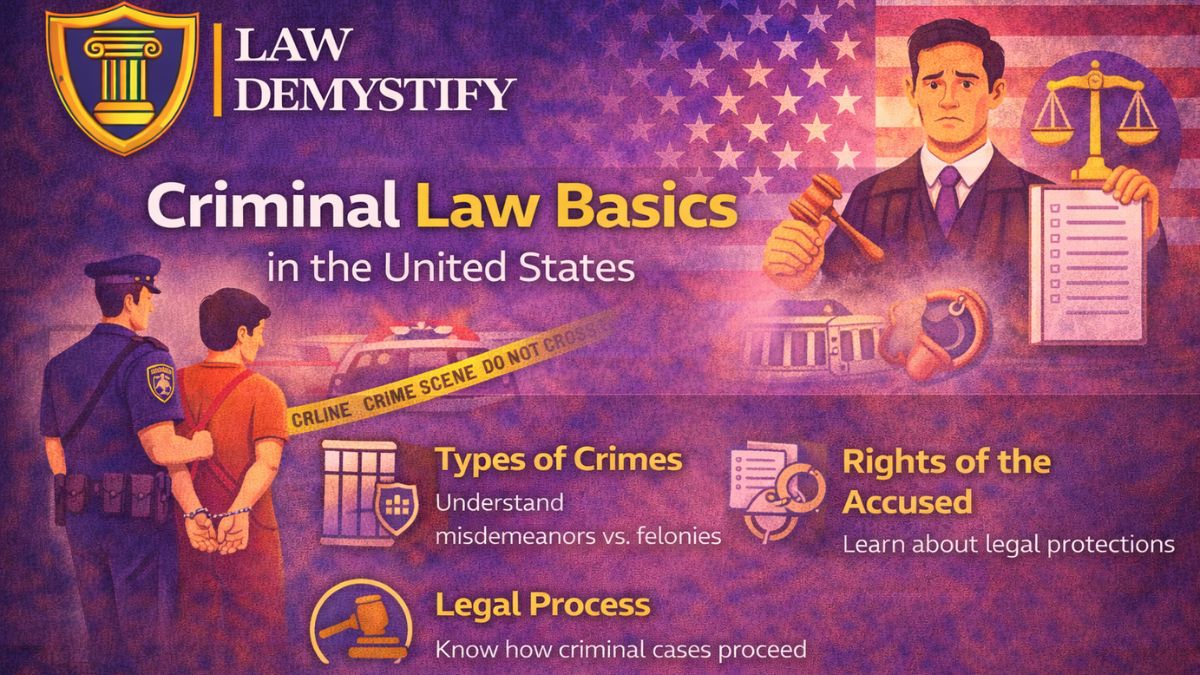
When someone is arrested, investigated, or formally charged, life can change in an instant. What begins as a misunderstanding, a heated dispute, or an unexpected police visit can quickly become a criminal case with serious consequences.
Criminal law in the United States defines what conduct is illegal, how prosecutors build cases, and what constitutional protections apply to the accused. Understanding how the system actually works can reduce fear, prevent costly mistakes, and protect long-term rights.
Unlike civil disputes between private parties, criminal cases are brought by the government. When a prosecutor files charges, it is done in the name of the state or the United States. The alleged harm is considered a violation against society as a whole. At first glance, criminal law may seem straightforward. In reality, it rarely is.
For tenants, landlords, and property owners, understanding criminal law basics in the United States is especially important because housing-related conflicts sometimes move beyond civil disagreements and enter criminal territory. Allegations involving property damage, fraud, theft, harassment, domestic violence, illegal entry, identity theft, or financial misconduct may trigger a criminal investigation even when the underlying relationship is contractual.
This guide explains how the system works, what constitutional rights apply, how federal and state authority differ, how criminal procedure operates, and how real-world housing and consumer situations intersect with criminal law. This content is for educational and informational purposes only and does not constitute legal advice. Laws vary by state, and readers should consult a licensed attorney for advice specific to their situation.
What Is Criminal Law in Simple Terms?
Criminal law is the body of law that defines prohibited conduct and establishes punishment for violations. Under criminal law basics in the United States, legislatures enact statutes that describe criminal offenses. Courts interpret those statutes. Prosecutors must prove that every legal element of the charged offense occurred.
A crime generally requires two components:
- A prohibited act (called actus reus)
- A required mental state (called mens rea)
For example, accidentally breaking a window during a storm is not typically a crime. Intentionally damaging property to cause loss may qualify as criminal mischief or vandalism, depending on state law.
In practice, this usually means that not every harmful event leads to criminal liability. Intent, knowledge, recklessness, and negligence all affect how statutes apply.
Understanding criminal law basics in the United States requires recognizing that the burden of proof always rests with the government. The accused does not have to prove innocence.
Federal vs. State Criminal Law: Who Has Authority to Prosecute?
Under the U.S. criminal justice system, authority is divided between federal and state governments. This dual system means that the same conduct may sometimes fall under state jurisdiction, federal jurisdiction, or both.
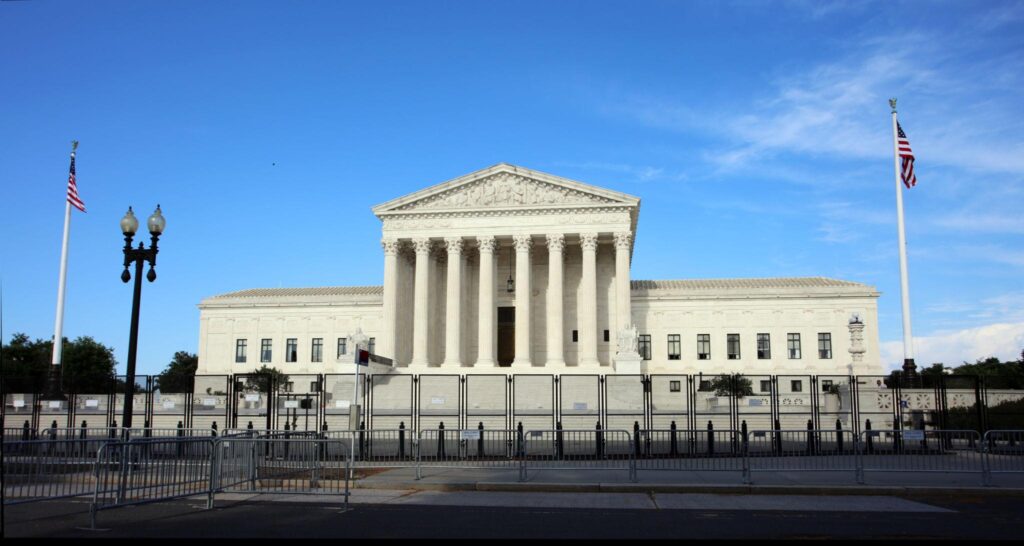
Federal criminal law applies to offenses involving interstate commerce, federal property, immigration violations, federal tax crimes, large-scale drug trafficking, and financial crimes crossing state lines. These cases are prosecuted by the United States Attorney’s Office in federal district courts.
State criminal law governs most day-to-day offenses, including assault, theft, burglary, domestic violence, DUI, and property damage. State prosecutors file charges in state courts under statutes enacted by state legislatures.
Many people are surprised to learn that the same conduct can sometimes trigger both state and federal investigations.
Felony Definition
A felony is a serious criminal offense typically punishable by more than one year in prison. Felonies may include crimes such as burglary, robbery, aggravated assault, significant fraud, or certain drug trafficking offenses.
States often divide felonies into classes or degrees, with penalties increasing based on severity and prior convictions. Some states impose mandatory minimum sentences for specific felonies.
Beyond incarceration, felony convictions can result in long-term consequences. These may include restrictions on firearm ownership, voting limitations in certain states, employment barriers, immigration consequences, and housing eligibility challenges. Because of these collateral effects, felony charges carry significant legal and practical impact.
Misdemeanor Definition
A misdemeanor is a less serious criminal offense usually punishable by up to one year in local jail, probation, community service, or fines. Examples often include minor theft, disorderly conduct, simple assault, or low-level property damage.
Although less severe than felonies, misdemeanor convictions still create criminal records. In some states, repeat misdemeanor offenses can be elevated to felony status. Courts may also impose probation conditions requiring counseling, restitution, or compliance monitoring.
Even minor convictions may appear in background checks, affecting professional licensing and rental applications.
Presumption of Innocence and the Burden of Proof
One of the most important principles in criminal law basics in the United States is the presumption of innocence. Every person accused of a crime is presumed innocent unless and until the government proves guilt beyond a reasonable doubt.
The burden of proof rests entirely on the prosecution. The accused does not have to prove innocence, produce evidence, or testify. If the government fails to establish every required element of the offense, the jury must return a not guilty verdict.
This high standard protects individuals from wrongful convictions and reflects the constitutional commitment to fairness in criminal proceedings.
What Does “Beyond a Reasonable Doubt” Mean?
“Beyond a reasonable doubt” is the highest standard of proof in the American legal system.
Under the American criminal law framework, prosecutors must present evidence so convincing that a reasonable person would have no logical doubt about the defendant’s guilt.
This standard exists to protect individuals from wrongful convictions and to ensure fairness in criminal proceedings. It also explains why some cases are dismissed when the evidence is insufficient.
For example, if the evidence shows that someone was present at a crime scene but does not clearly establish intent or participation, a jury may determine that reasonable doubt still exists. Suspicion alone is not enough. The prosecution must eliminate logical uncertainty before a conviction can occur.
What Happens After Arrest?
After arrest, the accused is typically transported to a detention facility for booking. Law enforcement documents include identifying information, photographs, fingerprints, and the alleged offense.
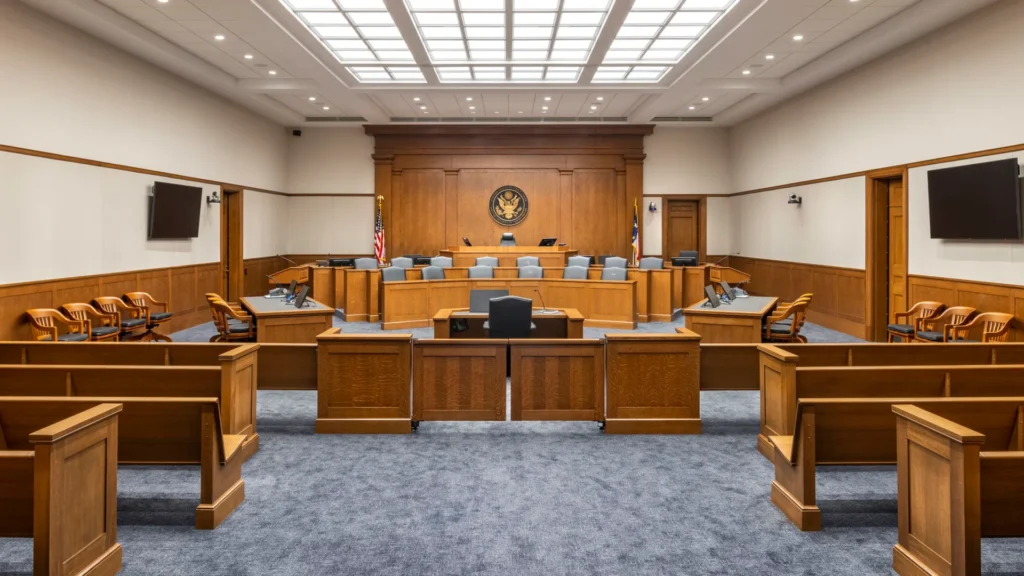
After booking, the prosecutor reviews the available evidence to determine whether formal criminal charges will be filed. If charges proceed, the accused appears before a judge for a first court appearance, often called an arraignment.
At this stage, the judge informs the defendant of the charges, addresses bail, and sets future court dates. If the offense is serious, additional pretrial procedures such as grand jury review or preliminary hearings may follow.
For many individuals, the period immediately following an arrest feels overwhelming. There may be confusion, fear, and uncertainty about what happens next. However, the criminal justice system follows a structured process, even if it may not feel orderly at the moment.
Booking Process After Arrest
Booking is the administrative process that occurs after arrest and before the first court appearance. During booking, law enforcement records personal information, conducts database checks, and creates an official arrest record.
This process typically includes photographing the accused (mugshot), fingerprinting, and collecting identifying details. Officers may also inventory personal belongings and conduct limited health screenings.
In many jurisdictions, a standard bail amount may be assigned based on a schedule tied to the offense. However, judges retain discretion to modify bail during the first appearance. The booking stage creates the initial official documentation of the criminal case, which becomes part of the court record.
Criminal Court Process Step by Step
The criminal court process, step by step, begins with arrest or summons and moves through arraignment, pretrial proceedings, trial or plea agreement, and sentencing. Each stage follows constitutional safeguards designed to protect due process.
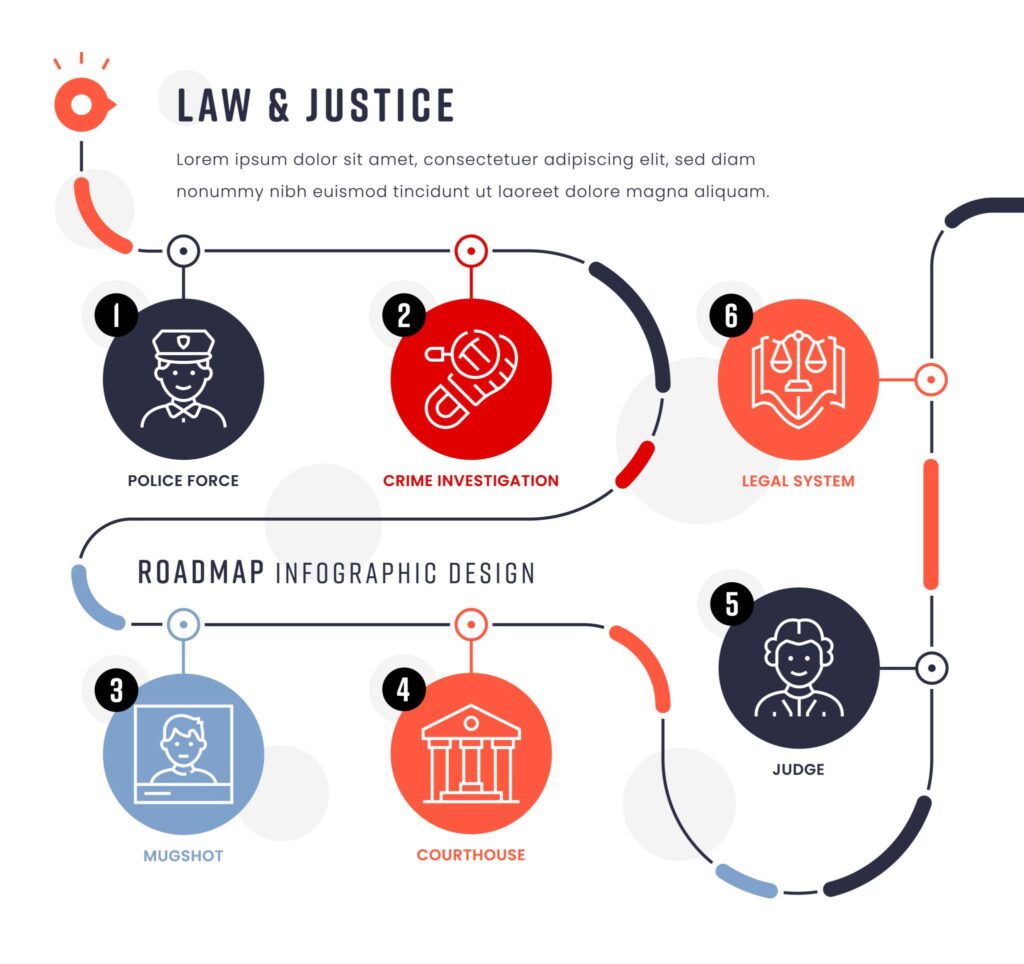
After arrest, prosecutors review evidence and formally file charges. At arraignment, the defendant enters a plea, and bail is addressed. Pretrial stages may include motions to suppress evidence, discovery exchange, and plea negotiations. If the case does not resolve, it proceeds to trial, where the government must prove guilt beyond a reasonable doubt. If convicted, sentencing follows. The exact structure varies by state, but the constitutional foundation remains consistent nationwide.
First Court Appearance Meaning
A first court appearance, often called an arraignment or initial appearance, is the defendant’s first formal hearing before a judge after charges are filed. During this proceeding, the court informs the accused of the charges and explains legal rights.
The judge may determine bail, appoint counsel if the defendant cannot afford one, and schedule future court dates. This hearing is not a trial and does not determine guilt. It ensures that the accused understands the allegations and that constitutional protections are observed. Failing to appear at this stage can result in a bench warrant and additional legal consequences.
Miranda Rights Explained
Miranda rights are constitutional warnings given by law enforcement before custodial interrogation to protect a suspect’s Fifth Amendment right against self-incrimination. These warnings typically include the right to remain silent and the right to an attorney.
The requirement for these warnings was established by the U.S. Supreme Court in Miranda v. Arizona, which strengthened Fifth Amendment protections during custodial interrogation.
Law enforcement must provide Miranda warnings when a person is both in custody and being interrogated. If warnings are not properly given, statements may be excluded from evidence. However, failure to read Miranda rights does not automatically dismiss charges; it primarily affects admissibility of statements. Understanding Miranda rights helps individuals avoid unintentionally waiving constitutional protections during questioning.
Right to Remain Silent Explained
The right to remain silent allows individuals to refuse to answer questions that may incriminate them. This protection arises from the Fifth Amendment of the United States Constitution.
To properly exercise this right, an individual must clearly and affirmatively state the intention to remain silent. Simply remaining quiet without explicitly invoking the right may not always provide full legal protection. Courts have held that, in many circumstances, the right must be clearly asserted.
Importantly, invoking the right to remain silent cannot legally be used as evidence of guilt. This safeguard is especially critical during emotionally charged situations — such as domestic disputes or property-related conflicts — where statements made in frustration or confusion may later be introduced in court.
Fifth Amendment Explained
The Fifth Amendment protects individuals from self-incrimination, double jeopardy, and deprivation of life, liberty, or property without due process of law. In criminal cases, it is most commonly associated with the right to remain silent.
The amendment ensures that the government cannot force a person to testify against themselves. It also prevents someone from being prosecuted twice for the same offense after acquittal or conviction. Additionally, due process protections require fair procedures before the government can impose penalties. The Fifth Amendment forms a central pillar of constitutional criminal procedure.
What Is Double Jeopardy?
Double jeopardy is a constitutional protection that prevents a person from being prosecuted more than once for the same offense after an acquittal or conviction. This protection comes from the Fifth Amendment of the United States Constitution.
Under criminal law basics in the United States, once a defendant has been found not guilty, the government generally cannot retry the same charge simply because it disagrees with the verdict. Similarly, after a conviction, the state cannot bring the same criminal charge again based on the same facts.
Double jeopardy also protects against multiple punishments for the same offense in a single proceeding. Courts must ensure that sentencing does not unlawfully stack penalties for the same criminal act under duplicative statutes.
There is, however, a limited exception known as the dual sovereignty doctrine. In certain circumstances, both a state government and the federal government may prosecute the same conduct if it violates separate sovereign laws. This exception is narrow and depends on jurisdictional authority.
Understanding double jeopardy protections reinforces one of the central principles of criminal law basics in the United States: once the justice system reaches a final decision, individuals are protected from repeated prosecution for the same offense.
Sixth Amendment Explained
The Sixth Amendment guarantees the right to a speedy and public trial, the right to an impartial jury, the right to confront witnesses, and the right to legal counsel. These protections apply in criminal prosecutions.
The right to counsel ensures that defendants have legal representation. If a person cannot afford an attorney, the court must appoint one in cases involving potential incarceration. The confrontation clause allows defendants to cross-examine witnesses. Speedy trial protections prevent excessive delays. Together, these rights safeguard fairness within the criminal justice system.
The constitutional right to appointed counsel in state criminal cases was firmly established in Gideon v. Wainwright, ensuring that defendants facing incarceration are not left without legal representation due to financial hardship.
How Sentencing Works in Criminal Cases
Sentencing occurs after a conviction or guilty plea. Courts determine punishment based on statutory ranges, sentencing guidelines, and case-specific factors.
Sentencing is often the moment when the consequences of a criminal case become most tangible. Families may be present in the courtroom. Employment, housing stability, and financial security may all be affected. Judges are required to consider both punishment and fairness under the law.
Criminal penalties may include:
- Jail or prison incarceration
- Probation supervision
- Monetary fines
- Restitution to victims
- Community service
- Mandatory minimum sentences in certain offenses
Judges often consider aggravating factors (such as prior convictions or use of a weapon) and mitigating factors (such as lack of criminal history or cooperation).
In federal court, sentencing guidelines provide structured calculations based on offense level and criminal history category. State sentencing systems vary widely.
What Rights Do Accused Individuals Have?
Under criminal law basics in the United States, individuals accused of crimes are protected by several core constitutional safeguards. These include the right to remain silent, the right to an attorney, the right to a speedy and public trial, the right to confront witnesses, and protection against unlawful searches and seizures.
These protections apply at every stage of the criminal process. Invoking constitutional rights cannot legally be treated as evidence of guilt. Understanding these rights helps individuals avoid self-incrimination and ensures that government authority is exercised within constitutional limits.
Collateral Consequences of a Criminal Conviction
A criminal conviction may result in consequences that extend beyond incarceration or fines. These are often called collateral consequences.
They may include:
- Employment limitations
- Professional licensing restrictions
- Immigration consequences
- Firearm ownership prohibitions
- Public housing ineligibility
- Difficulty passing rental background checks
For landlords, tenants, and property owners, understanding these consequences is critical because criminal records may affect housing eligibility and screening decisions.
Even years after a sentence is completed, individuals may face difficulty securing employment or passing a rental background check due to a past conviction.
What Is a Criminal Appeal and Post-Conviction Relief?
A criminal appeal is a formal request for a higher court to review potential legal errors that occurred during trial. Appeals do not retry the case or introduce new evidence. Instead, appellate courts review the legal record to determine whether mistakes affected the outcome.
Possible appellate results include:
- Affirming the conviction
- Reversing the conviction
- Ordering a new trial
- Modifying the sentence
In addition to appeals, post-conviction remedies such as habeas corpus petitions may challenge constitutional violations.
Can a Criminal Record Be Expunged or Sealed?
In some states, certain criminal records may be eligible for expungement or sealing. While laws vary significantly, these procedures may limit public access to criminal history records under specific conditions.
Eligibility often depends on:
- The type of offense
- Whether the conviction was a misdemeanor or a felony
- Completion of probation
- Waiting periods
- Absence of new criminal charges
Expungement and record sealing do not automatically apply and typically require formal court petitions. Because rules differ by state, individuals should consult qualified counsel for eligibility evaluation.
How Much Does a Criminal Lawyer Cost?
Legal fees vary widely depending on the severity and complexity of charges. Costs may differ significantly between misdemeanor and felony cases.
Because legal fees vary widely by jurisdiction and case complexity, individuals should consult qualified local counsel for case-specific cost estimates.
How Long Do Criminal Cases Take? (Felony, Misdemeanor, and Federal)
The length of a criminal case depends on the severity of charges, court backlog, complexity of evidence, and whether the case resolves through a plea agreement or proceeds to trial.
Felony Cases
Felony cases often take several months — and in many situations, more than a year — to resolve. Serious matters involving extensive evidence, expert witnesses, or multiple defendants may require additional time.
Felony prosecutions commonly include preliminary hearings or grand jury proceedings, formal discovery exchanges, pretrial motion practice, and extensive trial preparation.
Continuances requested by either the prosecution or the defense can further extend the overall timeline of the case.
Misdemeanor Cases
Misdemeanor cases generally resolve faster, often within a few months. Many conclude through negotiated plea agreements rather than a trial. However, scheduling conflicts, court congestion, and evidentiary issues can still result in multiple appearances before final resolution.
Federal Criminal Cases
Federal criminal cases are often more structured and lengthy than state prosecutions. Federal investigations may continue for months — or even years — before an arrest occurs.
After an indictment is returned, the case proceeds through arraignment, discovery, pretrial motion practice, and, if not resolved, trial. If a conviction results, sentencing follows under the Federal Sentencing Guidelines, which calculate penalties based on the offense level and the defendant’s criminal history category.
Because of these formal procedural requirements and structured guideline calculations, federal cases frequently take longer to resolve than state-level prosecutions.
Delays in any criminal case do not automatically indicate weakness. In many situations, extended timelines reflect constitutional safeguards and the careful preparation required to protect the rights of the accused.
What Is Criminal Procedure and Why Does It Matter?
Criminal procedure refers to the rules governing how criminal cases are investigated and prosecuted. Under criminal law basics in the United States, these procedures are rooted in constitutional protections.
- The Fourth Amendment protects against unreasonable searches and seizures.
- The Fifth Amendment protects against self-incrimination.
- The Sixth Amendment guarantees the right to counsel and trial.
- The Fourteenth Amendment ensures due process.
Criminal procedure determines whether police need a warrant, how interrogations must be conducted, how evidence is admitted, and how trials are structured.
This becomes especially important when housing-related investigations occur. If officers search a rental unit without lawful authority, defense counsel may challenge the evidence. If Miranda warnings are required but not properly given during custodial interrogation, statements may be suppressed.
Understanding procedural safeguards is central to mastering criminal law basics in the United States.
What Is an Arraignment and What Happens There?
An arraignment is the defendant’s first formal court appearance after criminal charges are filed.
At the arraignment:
- The charges are formally read in court.
- The defendant enters a plea (guilty, not guilty, or no contest).
- Bail or release conditions are addressed.
Under criminal law basics in the United States, an arraignment also triggers important procedural timelines. In many jurisdictions, statutory speedy trial deadlines begin at this stage.
For example:
- California sets specific timeframes following arraignment for trial commencement.
- Florida provides structured speedy trial periods for misdemeanors and felonies.
- Texas applies procedural rules that vary depending on the nature and severity of the offense.
Failure to appear at an arraignment can result in a bench warrant for the defendant’s arrest.
What Is an Indictment and When Is It Required?
An indictment is a formal charging document issued by a grand jury. In federal felony cases, an indictment is generally required unless waived.
Under criminal law basics in the United States, an indictment means that a grand jury determined probable cause exists to believe a crime was committed. It is not a finding of guilt.
Some states require grand jury indictments for certain felonies. Others allow prosecutors to file charges directly through a criminal information.
Understanding whether a case proceeds by indictment affects timelines and strategy.
What Is a Grand Jury and How Does It Work?
A grand jury is a group of citizens who review evidence presented by prosecutors to decide whether formal charges should be filed.
Grand jury proceedings are usually confidential. The accused and defense counsel typically do not present a full defense during this stage.
Grand juries are common in federal cases, including complex financial crimes, housing fraud schemes, and interstate offenses.
Under criminal law basics in the United States, the grand jury’s role is limited to determining probable cause—not guilt beyond a reasonable doubt.
What Are the Main Types of Criminal Charges?
Criminal offenses are generally categorized as infractions, misdemeanors, or felonies.
- Infractions typically involve minor violations and usually result in fines rather than jail time.
- Misdemeanors are generally punishable by up to one year in local jail.
- Felonies carry longer prison sentences and more severe collateral consequences.
Under criminal law basics in the United States, the classification of an offense depends on statutory definitions and often considers monetary thresholds, intent, and prior criminal history.
Examples in Housing-Related Contexts
- Criminal mischief for intentional property damage
- Theft of appliances or fixtures
- Fraudulent rental applications
- Burglary involving unlawful entry
- Assault arising from landlord-tenant altercations
States define these offenses differently. For example:
- In New York, criminal mischief degrees depend on the value of the damage.
- In Texas, theft severity escalates based on the dollar amount involved.
- In Florida, burglary classifications depend on whether a dwelling is involved.
Understanding these distinctions helps individuals assess potential exposure, legal risk, and long-term consequences.
What Is Bail and How Does Pretrial Release Work?
Bail allows an accused person to remain free while awaiting trial, subject to court-imposed conditions.
When determining bail, judges typically consider:
- Risk of flight
- Danger to the community
- Severity of the charges
- Criminal history
Under criminal law basics in the United States, bail is intended to ensure a defendant’s appearance in court, not to serve as punishment.
How Bail Systems Differ by State
States vary significantly in how they approach pretrial release:
- New Jersey relies heavily on risk assessment tools rather than traditional cash bail.
- New York has reformed its bail laws to limit cash bail for many non-violent offenses.
- Texas continues to use monetary bail systems, though they remain subject to ongoing legal scrutiny and reform efforts.
Violating bail conditions — such as failing to appear in court or committing a new offense — can result in revocation of release and additional criminal charges.
What Is a Plea Bargain and Why Are They Common?
A plea bargain is a negotiated agreement between the prosecution and defense to resolve a case without trial.
The majority of criminal cases in the United States are resolved through plea agreements.
Under criminal law basics in the United States, plea agreements may involve reduced charges or recommended sentencing concessions. However, a guilty plea creates a criminal conviction record.
This can affect housing eligibility, professional licensing, and employment opportunities.
What Is the Difference Between Probation and Parole?
Probation is a court-ordered alternative to incarceration imposed at sentencing.
Parole is supervised release after serving part of a prison sentence.
Under U.S. criminal procedure framework, probation violations may result in jail. Parole violations may lead to reincarceration.
States administer supervision differently. California uses structured probation systems. Florida applies community control programs. Texas maintains detailed supervision conditions.
Understanding supervision terms is critical for compliance.
What Is the Statute of Limitations in Criminal Cases?
The statute of limitations sets the legal deadline for prosecutors to file criminal charges.
Under criminal law basics in the United States, limitation periods vary widely depending on the type of offense and the jurisdiction involved.
State approaches differ significantly:
- California has no statute of limitations for certain serious felonies but imposes deadlines for many other offenses.
- Texas applies different timeframes depending on the severity of the crime.
- New York distinguishes limitation periods based on felony class.
- Florida sets varying deadlines according to statutory classification.
For the most serious offenses, such as murder, there is often no statute of limitations, meaning charges can be filed at any time.
How Criminal Law Intersects with Housing and Consumer Issues
In practice, the key question is whether the conduct involved keeps the matter civil, or elevates it into criminal territory.
For example, a heated landlord-tenant dispute that results in property damage may begin as a civil disagreement. However, it can quickly escalate into criminal charges if intentional destruction, threats, or violence are alleged.
Consider the distinctions:
- If a tenant fails to pay rent, the issue is generally civil.
- If a tenant intentionally commits fraud to obtain housing, criminal statutes may apply.
- If a landlord engages in identity theft or fraudulent billing schemes, a criminal investigation may follow.
This distinction becomes especially important when individuals mistakenly assume that police involvement replaces formal eviction procedures. It does not. Law enforcement presence does not eliminate the requirement to follow lawful civil eviction processes.
Understanding constitutional criminal protections — including due process rights — helps prevent unnecessary escalation and ensures awareness of legal boundaries on both sides of a dispute.
How Criminal Law Applies in Real-Life Situations
In real-world housing and consumer disputes, the line between civil and criminal conduct can become blurred.
For example:
- A tenant who simply fails to pay rent faces a civil eviction, not criminal prosecution.
- A tenant who intentionally destroys property may face criminal mischief charges.
- A landlord who changes locks without a court order may face civil penalties, and in some jurisdictions, potential criminal exposure if force or threats are involved.
- Submitting fraudulent income documents on a rental application may trigger criminal fraud charges.
- Filing a knowingly false police report during a dispute may itself be a criminal offense.
Understanding these distinctions helps prevent escalation and protects legal rights on both sides.
Common Misunderstandings About Criminal Law
Several widespread misconceptions can create serious legal problems:
- “If the victim drops charges, the case automatically ends.”
- “If police did not read Miranda rights, the case is dismissed.”
- “Minor misdemeanors do not affect background checks.”
- “Talking to investigators without a lawyer will help clear things up.”
In reality, prosecutors—not victims—control criminal cases. Miranda violations affect admissibility of statements, not automatic dismissal. Even misdemeanor convictions can appear in background checks. Speaking without legal counsel can unintentionally harm a defense.
Common Mistakes That Affect Legal Rights
Individuals sometimes weaken their position by:
- Speaking to investigators without counsel
- Missing court dates
- Violating protective or bail orders
- Posting case details publicly
Discussing a pending case on social media or with third parties can unintentionally create evidence that may later be used in court.
Under the American criminal justice system, missing court appearances may result in arrest warrants. Violating court conditions can create new charges.
In some cases, early legal intervention may prevent formal charges from being filed, particularly when misunderstandings or incomplete evidence are involved.
When Should You Contact a Criminal Defense Lawyer?
Individuals should consider contacting a criminal defense attorney as soon as they become aware of a potential investigation or charge.
Legal representation is especially important if:
- Law enforcement requests an interview
- A search warrant is executed
- You are arrested or cited
- You receive a grand jury subpoena
- You are formally charged
Early legal guidance can protect constitutional rights, prevent self-incrimination, and shape defense strategy before critical procedural deadlines pass.
Frequently Asked Questions
Can criminal charges proceed even if the alleged victim does not want to press charges?
Yes. Prosecutors decide whether to pursue charges based on evidence and public interest considerations.
Does an arrest automatically mean someone is guilty?
No. Under criminal law basics in the United States, individuals are presumed innocent unless convicted.
Can someone be prosecuted in both state and federal court for the same conduct?
In limited circumstances, dual sovereignty allows separate prosecutions.
Does a misdemeanor conviction appear on a background check?
Yes, unless expunged or sealed under state law.
What happens if someone violates probation?
The court may revoke probation and impose additional penalties.
Are federal sentences always harsher than state sentences?
Not necessarily. Severity depends on statutory guidelines and case facts.
Can a criminal conviction affect rental eligibility?
Yes. Landlords may consider criminal history, subject to housing law compliance.
Final Thoughts on Criminal Law Basics in the United States
Criminal law basics in the United States shape the balance between government authority and individual liberty, affecting real people, real families, and real futures. From arrest through sentencing and potential appeal, the system operates within a framework designed to protect constitutional safeguards while maintaining public safety.
For tenants, landlords, and property owners, understanding when a dispute crosses from civil disagreement into criminal exposure is essential. Early awareness of constitutional protections, procedural safeguards, and potential long-term consequences can significantly impact legal outcomes.
If you or someone you care about is facing investigation, arrest, or formal criminal charges, do not delay in understanding your rights. Early legal guidance can protect your freedom, your record, and your future.
Criminal cases move quickly. Decisions made in the first hours or days can shape outcomes for years. Consulting a qualified criminal defense attorney licensed in your state can provide clarity, protect your rights, and position you for the strongest possible defense.