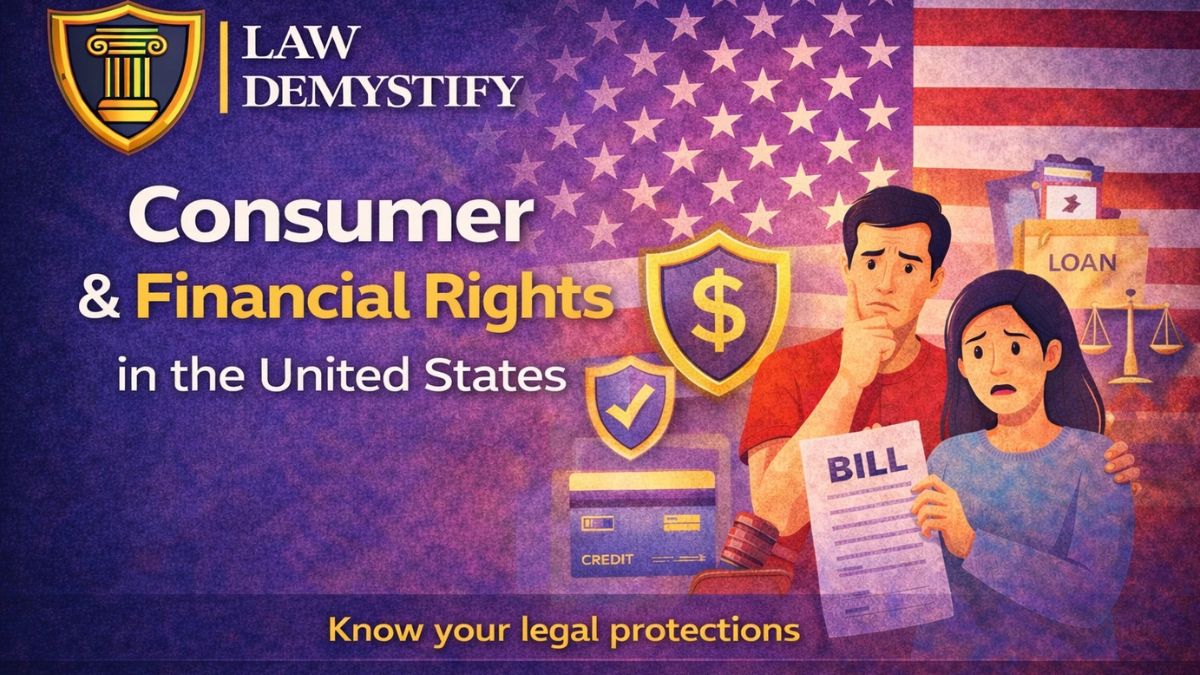
These protections affect far more than major purchases—they shape everyday financial decisions people make without a second thought. Most people do not think about consumer protection laws until something goes wrong. In the United States, everyday financial life often feels routine—paying rent, swiping a credit card, setting up auto-payments. But when a charge looks wrong, a fee appears without explanation, or a debt notice arrives unexpectedly, that routine quickly turns into stress. This is where consumer rights USA and consumer protection laws USA move from theory into real life.
This guide explains how U.S. consumer and financial protections work, who enforces them, and how they apply in real-world situations. It is written for people seeking a clear, accurate understanding of the law—without legal jargon and without unrealistic promises.
This guide provides general information about U.S. consumer protection laws and financial rights and is intended to help consumers understand how these laws work in everyday situations. It is not legal advice and does not create an attorney-client relationship. Consumer protection laws vary by state, and individual situations may require advice from a licensed consumer protection attorney.
The Legal Foundation of Consumer Rights in the United States
The modern concept of consumer rights USA developed in response to rapid economic growth, expanding credit markets, and the increasing power imbalance between large companies and individual customers. Federal lawmakers recognized early that consumers often lacked bargaining power, access to information, and effective remedies when financial harm occurred.
At the federal level, Congress enacted a series of statutes that now form the backbone of consumer protection laws USA. These laws establish baseline rights nationwide, regardless of where a consumer lives. States then build on this foundation by adding additional protections through state statutes, regulations, and court decisions.
This federal–state structure is intentional—and it matters in everyday situations. A consumer in California may have stronger remedies than someone in another state, even though both are protected by federal consumer rights USA. Understanding this difference can directly affect whether a dispute is worth pursuing.
Federal Authority and the Role of Consumer Protection Agencies
Several federal agencies share responsibility for enforcing consumer protection laws USA, but one agency plays a central role in financial matters—the Consumer Financial Protection Bureau (CFPB). Many consumers first encounter the CFPB after a dispute with a credit card issuer, a loan servicer, or a debt collector that refuses to correct an obvious error.
The CFPB’s authority includes:
- Supervising covered financial institutions for compliance with federal law
- Investigating unfair, deceptive, or abusive financial practices
- Issuing regulations that clarify how consumer laws apply in real transactions
Other federal agencies also contribute to enforcement. The Federal Trade Commission addresses deceptive advertising and unfair business practices, while banking regulators supervise federally chartered banks. Together, these agencies ensure that consumer rights USA are not merely theoretical but actively enforced.
State Consumer Protection Laws and Why They Matter
While federal law sets the floor, state law often provides the ceiling. State consumer protection statutes—sometimes called “unfair and deceptive acts and practices” laws—frequently allow broader remedies, longer filing deadlines, or higher penalties.
For example, some states permit consumers to recover statutory damages even when actual financial loss is small. Others allow courts to award attorney’s fees to successful consumers, making it economically feasible to challenge misconduct. These state-level enhancements exist alongside consumer protection laws USA, meaning consumers often have more rights than they realize depending on where they live.
In landlord-tenant contexts, state law becomes especially important. If a tenant pays rent through an online portal that adds undisclosed processing fees, state consumer statutes may provide relief beyond what federal law offers. Understanding both layers is essential to fully appreciating consumer rights USA.
Financial Transactions and Consumer Rights in Everyday Life
Most consumer protection disputes arise from routine financial transactions—the kinds people rarely think twice about until something feels wrong. These include monthly billing statements, subscription renewals, and automatic withdrawals. The law focuses on transparency, accuracy, and fairness.
Consumers have the right to receive clear disclosures before agreeing to financial terms. This applies whether you are opening a credit card account, signing a lease that requires electronic rent payments, or enrolling in a payment plan. Hidden fees, misleading pricing, and confusing contract language may violate consumer protection laws USA if they prevent informed decision-making.
Equally important is the right to dispute errors. When a consumer identifies a billing mistake—such as being charged twice for rent, billed for a service that was canceled, or seeing unexplained “processing fees” added to a monthly payment—the law does not expect silence or acceptance. Consumer rights USA give individuals a structured way to dispute errors and demand correction.
Credit, Borrowing, and Legal Protections for Consumers
Access to credit is central to modern life, but it also carries risk. U.S. law recognizes this by regulating how credit is offered, reported, and collected. These protections apply to credit cards, personal loans, auto financing, and even certain rent-to-own arrangements.
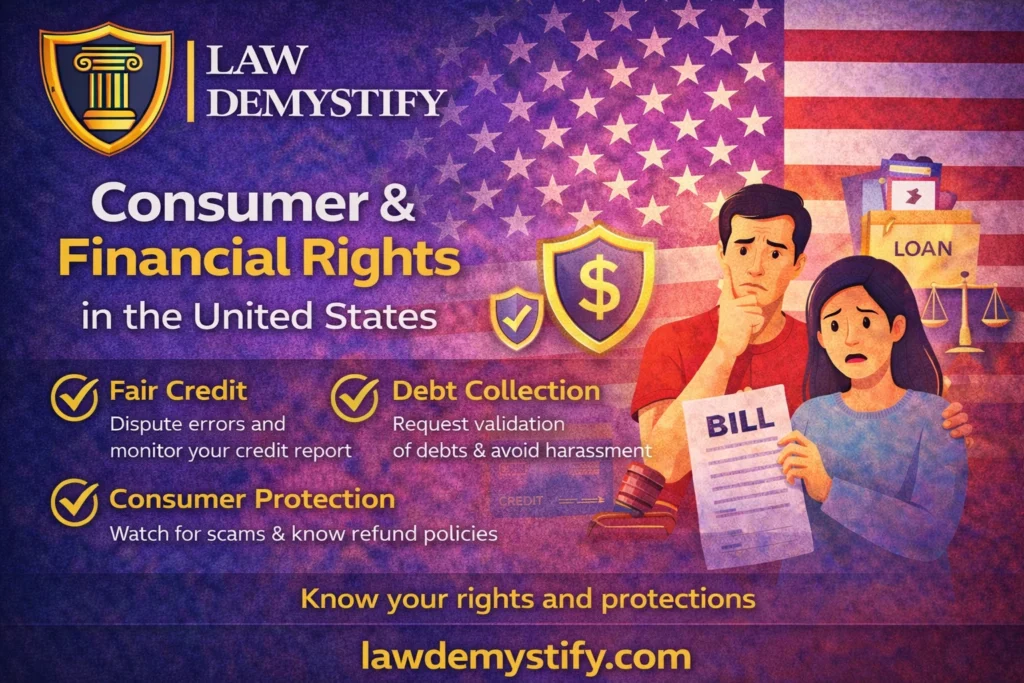
Consumers are entitled to accurate credit reporting because even a small error can have serious consequences, such as higher interest rates, rejected rental applications, or difficulty obtaining basic services. Consumer protection laws USA recognize that inaccurate reporting is not a minor inconvenience but a real financial harm.
Borrowers also benefit from disclosure requirements. Interest rates, fees, and repayment terms must be clearly stated before a consumer becomes legally obligated. Ambiguous or misleading disclosures undermine informed consent and may violate consumer rights USA.
Debt Collection Practices and Legal Boundaries
Debt collection is one of the most heavily regulated areas of consumer finance. The law does not prohibit debt collection, but it strictly limits how collectors may behave. These rules apply whether the debt arises from unpaid medical bills, credit card balances, or rent-related charges after a lease ends.
Collectors may not harass, threaten, or mislead consumers. They must provide validation of the debt upon request and must cease communication in certain circumstances. Importantly, these protections apply regardless of whether the debt is ultimately valid.
Many consumers first encounter debt collectors during already stressful periods, when finances are tight and communication feels overwhelming—such as during job loss, medical emergencies, or housing transitions—making legal boundaries especially important under consumer rights USA.
In housing-related disputes, debt collection issues often arise when landlords refer unpaid balances to third-party agencies. Tenants facing aggressive collection tactics may have remedies under consumer protection laws USA, even if they previously owed money.
Fraud, Unauthorized Charges, and Consumer Remedies
Financial fraud remains a significant concern nationwide. Unauthorized charges, identity misuse, and payment account takeovers can cause immediate and long-term harm. U.S. law addresses these risks by limiting consumer liability and imposing duties on financial institutions.
When a consumer promptly reports unauthorized transactions, liability is often capped or eliminated. Credit card issuers, banks, and payment processors must investigate claims and restore funds when fraud is confirmed. These protections are integral to consumer rights USA and reflect a policy choice to place risk on institutions better equipped to prevent fraud.
Fraud can intersect with housing matters as well. For example, if a tenant’s payment information is stolen from a property management portal, both financial and consumer protection principles apply. Companies that fail to safeguard consumer data may face consequences under consumer protection laws USA.
Unfair Practices and the Concept of Legal Fairness
Not every harmful business practice involves outright fraud. Many disputes arise from conduct that is technically legal in isolation but unfair in context. U.S. consumer law addresses this through standards prohibiting unfair or deceptive practices.
A practice may be considered unfair if it causes substantial consumer harm that is not reasonably avoidable and is not outweighed by countervailing benefits. Deceptive practices involve misleading representations or omissions likely to affect consumer decisions. These concepts allow regulators and courts to address evolving business models without rewriting statutes for every new scenario.
In rental and housing-adjacent services, unfair practices might include undisclosed mandatory fees or confusing payment terms. When such conduct crosses legal boundaries, consumer rights USA provide mechanisms for accountability.
Remedies Available to Consumers Under U.S. Law
Consumer protection laws focus not only on prohibitions but also on remedies. Remedies may include refunds, account corrections, statutory damages, or injunctive relief requiring a company to change its practices.
Federal law often emphasizes corrective action—such as fixing billing errors or removing inaccurate credit information. State laws may go further by allowing additional monetary recovery. Together, these remedies reinforce compliance with consumer protection laws USA and deter misconduct.
While consumer protection laws USA offer meaningful remedies, legal outcomes are never automatic. The law provides tools, not guarantees, and results depend on evidence, timing, and applicable state or federal authority.
Time Limits, Deadlines, and Why Acting Quickly Matters
Consumer protection laws do not provide unlimited time to act. Most federal and state consumer statutes impose statutes of limitations—legal deadlines that determine how long a consumer has to dispute a charge, file a complaint, or bring a lawsuit.
These deadlines vary depending on the type of claim and whether federal or state law applies. Some billing dispute laws require notice within weeks or months, while certain state consumer protection claims may allow several years to file suit. Missing a deadline can eliminate legal remedies entirely, even when misconduct is clear.
Timely action is especially important in financial disputes involving credit reporting, debt collection, and unauthorized charges. Delay can make it harder to obtain records, prove errors, or stop ongoing harm. For this reason, consumer rights USA are strongest when exercised promptly and in accordance with required procedures.
Understanding and respecting time limits is part of using consumer protection laws effectively—not just knowing that rights exist.
What Consumers Should Do When Their Rights Are Violated
When something feels wrong, many consumers are unsure where to start. While outcomes vary, taking prompt and organized action often preserves important legal protections under U.S. consumer law.
- Document everything, including statements, emails, contracts, and payment confirmations
- Dispute errors in writing using the method required by law or account terms
- Monitor deadlines, as many consumer laws impose strict notice and filing time limits
- Report misconduct to appropriate agencies such as state attorneys general or federal regulators
- Consult a consumer protection attorney when financial harm is significant or ongoing
Consumer protection laws provide tools—not guarantees—and informed action improves outcomes.
Compliance Obligations for Businesses and Service Providers
Consumer protection law imposes affirmative obligations on businesses. Companies must implement systems to prevent errors, respond to disputes, and ensure transparency. Ignoring complaints or relying on complex fine print is not a defense when legal duties exist.
Landlords, property managers, lenders, and payment processors all fall within the scope of consumer protection laws USA when they engage in covered activities. Compliance is not optional, and failure to meet statutory standards can result in enforcement actions, penalties, and reputational harm.
From a legal perspective, compliance also benefits businesses by reducing disputes and fostering trust. Clear communication and fair practices align with both regulatory expectations and consumer confidence.
The Interaction Between Federal and State Enforcement
Federal agencies and state attorneys general often work together to enforce consumer rights USA. Joint investigations and coordinated settlements are common, especially in cases involving widespread harm. This cooperation enhances enforcement reach and ensures consistent application of the law.
Consumers may also pursue private actions under certain statutes. While federal agencies focus on systemic issues, private lawsuits address individual harm. State law frequently expands access to courts by providing longer statutes of limitations or additional remedies.
Understanding this layered enforcement structure helps consumers appreciate why protections are robust and why outcomes can vary by jurisdiction.
Government Enforcement vs Private Consumer Lawsuits
Consumer protection laws are enforced in two primary ways: government action and private lawsuits. Both play important but different roles in protecting consumer rights USA.
Federal and state agencies focus on systemic misconduct that affects large numbers of people. Their actions may result in fines, consent orders, or industry-wide changes, but individual consumers do not always receive direct compensation.
Private lawsuits, by contrast, address individual harm. Many consumer protection laws allow consumers to sue businesses directly for violations, sometimes permitting recovery of statutory damages, attorney’s fees, or court-ordered corrections. This private enforcement mechanism ensures that companies remain accountable even when government agencies are unable to pursue every case.
Not every dispute justifies litigation, and many consumer issues are resolved without ever going to court. Outcomes also depend on evidence and applicable law. However, the availability of private lawsuits is a key reason consumer protection laws USA remain effective in everyday transactions.
Practical Examples of Consumer Rights in Action
Consider a tenant who pays rent through an online platform that automatically adds service fees not disclosed in the lease. If the fees are misleading or unavoidable, they may implicate consumer protection laws USA. Another example involves a borrower charged interest at a rate higher than advertised due to unclear terms. Disclosure requirements under consumer rights USA address this imbalance.
These scenarios demonstrate how consumer law operates in everyday life. The law does not require perfection from businesses, but it does require honesty, transparency, and fairness.
Example: Subscription Billing and Automatic Renewals
A consumer signs up for a low-cost trial subscription but later discovers recurring monthly charges that were not clearly disclosed. If cancellation steps are hidden or misleading, consumer protection laws USA may require refunds and changes to business practices.
This type of dispute highlights how transparency and consent remain central principles of consumer law—even in digital transactions designed for convenience.
Education, Awareness, and Responsible Financial Decision-Making
Legal protections are most effective when consumers understand them. Awareness of consumer rights USA empowers individuals to recognize problems early and respond appropriately. This includes reviewing statements, reading disclosures, and promptly disputing errors.
Education also promotes responsible business conduct. When companies know consumers are informed, compliance becomes part of competitive advantage rather than a regulatory burden.
Digital Payments, Subscriptions, and Emerging Consumer Risks
Modern consumer finance increasingly relies on digital platforms. Automatic renewals, mobile payment apps, and subscription-based services now dominate everyday transactions. While convenient, these systems create new risks that consumer protection laws USA must address.
Common issues include unclear cancellation policies, recurring charges that continue after services are canceled, and limited customer support for resolving billing disputes. In digital environments, consumers may not receive traditional paper statements and may only notice problems after charges quietly repeat month after month, making errors harder to detect.
Consumer protection laws apply regardless of whether transactions occur online or offline. Companies offering digital payment services must still provide clear disclosures, accurate billing, and meaningful dispute resolution processes. Failure to do so may constitute unfair or deceptive practices under consumer protection laws USA.
As digital finance evolves, consumers benefit most when they actively monitor accounts, review electronic disclosures, and understand that legal protections extend fully into online transactions.
Frequently Asked Questions
What protections do U.S. consumers have when billed incorrectly?
U.S. law requires companies to investigate disputed charges and correct confirmed errors under consumer protection laws USA, provided consumers follow required notice procedures.
Can state law provide more protection than federal consumer law?
Yes. States may offer stronger remedies or broader definitions of unfair practices alongside consumer rights USA.
Are online payment fees in rental transactions regulated?
If fees are misleading or undisclosed, they may violate consumer protection laws USA, depending on the facts and applicable state law.
How quickly must unauthorized charges be reported?
Timelines vary by account type, but prompt reporting preserves maximum protection under consumer rights USA.
Do consumer protections apply to small lenders and landlords?
Yes. Coverage depends on the activity, not just company size, under consumer protection laws USA.
Can inaccurate credit reporting be challenged?
Consumers have the right to dispute errors, and agencies must investigate under consumer rights USA.
Is every unfair outcome automatically a legal violation?
No. The law targets conduct that meets statutory standards of unfairness or deception under consumer protection laws USA.
Do consumer protection laws apply to online businesses?
Yes. Online companies, digital payment platforms, and subscription services are subject to consumer protection laws.
What happens if a company ignores a billing dispute?
Failure to investigate or respond may itself violate consumer protection laws and create additional liability.
Are landlords subject to consumer protection laws?
Yes. When landlords or property managers engage in billing, fee collection, or payment processing, consumer laws may apply.
Is proof required to dispute a charge?
Consumers should provide supporting documentation when available, but the law requires companies to investigate disputes in good faith.
Consumer protection law is a specialized area that intersects with financial regulation, housing law, and contract rights. Understanding these protections helps consumers make informed decisions, but legal outcomes depend on specific facts and applicable state and federal rules.
The Ongoing Evolution of Consumer Protection Law
Consumer and financial markets continue to evolve, especially with digital payments, automated billing, and data-driven services. Legislators and regulators regularly update rules to address emerging risks while preserving core principles of fairness and transparency.
As these developments unfold, the foundational concepts behind consumer rights USA remain constant. The law seeks to balance innovation with accountability, ensuring that individuals are not left vulnerable in increasingly complex financial environments. By understanding how consumer protection laws USA function, consumers and businesses alike can navigate financial relationships with greater confidence and legal clarity.